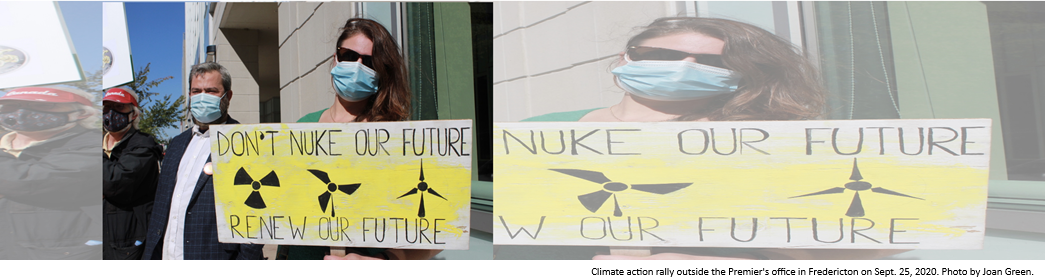
CRED-NB core member Ann McAlister, representing Council of Canadians Saint John, was featured in an NB Media Co-op article and video. Ann explained the history and outcome of CRED’s application to the federal Environment minister requesting that the SMRs planned for Point Lepreau in New Brunswick should undergo a federal impact assessment. Read the article HERE.
Tag: Other Org Action
‘My burning shame’: George Monbiot on wood-burning stoves

Prominent UK environmental writer George Monbiot writes in The Guardian this week about his shame and regret for converting his home to heat with wood-burning stoves. “Wood burners are incredibly bad for the environment – and flood our homes with toxins, too… Every time you open the stove door to refuel, your home is flooded with tiny particulates, accompanied by other toxins.” Read his article HERE.
In New Brunswick, the NB Lung Association recommends not burning wood for the same reason. Info on their website includes: “Burning wood is a major source of air pollution, and can have negative effects on the environment and human health. Smoke from wood combustion is the leading source of particulate emissions in New Brunswick. In fact, wood burning accounts for over 70% of total Particulate Matter 2.5 in the province, more than any industrial source.”
Clean Energy or Weapons? What the ‘Breakthrough’ in Nuclear Fusion Really Means

In contrast to the hype about nuclear fusion and its promise of limitless energy, experts have been analyzing the recent ‘breakthrough’ announcement. For example, UBC professor M.V. Ramana wrote this piece in Z Network, HERE. For another perspective, the Bulletin of Atomic Scientists interviews Bob Rosner, a physicist at the University of Chicago and a former director of the Argonne National Laboratory, article HERE.
CRED supports call for public hearings into future of Point Lepreau nuclear plant

On Friday, Dec. 15, the Conservation Council of New Brunswick did the right thing: they called for public hearings into the future of the Point Lepreau nuclear plant. Read the media release HERE.
Following the latest outage at the Point Lepreau nuclear plant on the Bay of Fundy on the morning of Wednesday, Dec. 14, NB Power issued several vague news releases. Business as usual, another day, another unscheduled shutdown.
NB Power puts its news releases HERE, including any updates on the Lepreau situation that they deign to share with us, the public. When will they switch it on again? Will they tell us what happened or keep us guessing?
CRED-NB fully supports the CCNB call. We look forward to an open and transparent hearing process where all the facts are laid bare. What is this intermittent power reactor costing us and how much is it going to cost us to keep it limping along until its licence runs out in 2032? The licence will be subject to a CRTC review in 2027 but that’s too far away. Let’s get the facts out in 2023.
Conservation Council of New Brunswick adopts resolution opposing nuclear power as future energy source
At its AGM at the end of November, the province’s flagship environmental organization, the Conservation Council of New Brunswick, adopted a motion opposing nuclear power as a future energy source and promoting instead investment in real climate solutions. The resolution was proposed by Dr. Janice Harvey, a CRED-NB core member. Read or download the CCNB resolution, HERE.
COP27 shows Higgs is out of touch with reality
Is our premier Blaine Higgs out of step with global trends for climate change mitigation? Read the analysis comparing the current reality reflected in the recent COP27 and the NB government’s shale gas ambitions. Commentary by Jim Emberger, CRED core member with the New Brunswick Anti-Shale Gas Alliance (NBASGA) published by the NB Media Co-op, HERE.
No legitimate reason to support the controversial nuclear technology planned for New Brunswick

NB Power plans to develop new nuclear reactors at Point Lepreau that will use a controversial technology with implications for global security. Provincial and federal government support for this technology–called reprocessing–should end. Separation of plutonium massively increases risk of nuclear weapons proliferation. Read the commentary by Susan O’Donnell (CRED-NB core member) and University of British Columbia professor M.V. Ramana, published in the NB Media Co-op HERE.
How can we encourage wind energy projects to succeed?
The Conservation Council of New Brunswick (CCNB) released the results of their year-long study to identify the factors that encourage successful wind energy projects. The research focused a wind energy project that failed to get off the ground in northern New Brunswick. Check out the report and more information on the CCNB website, HERE.
Energy technologies considered for New Brunswick are not clean, timely or affordable
Wind, solar and existing hydro are cheaper, cleaner, and ready to go, reducing our carbon emissions in a few years, not in a decade or two. Costly unproven projects like SMRs and hydrogen commit our money to rising costs and delayed payback. CRED core members Sam Arnold (NBASGA) and Ann McAllister (Council of Canadians Saint John Chapter) wrote a critique of New Brunswick’s current energy development plans and lay out an alternative. Commentary published by the NB Media Co-op, HERE.
Pull the plug on nuclear subsidies
Excellent article by Ole Hendrickson in the latest issue of Rabble:
https://rabble.ca/columnists/pull-the-plug-on-nuclear-subsidies/
Some quotes from the article:
New Brunswick Power, despite being awash in debt, is also promoting two “next generation” SMRs at its Point Lepreau reactor site. Both the provincial and federal governments have provided multi-million-dollar grants, ignoring warnings that these SMR designs, which would be fuelled by plutonium, have been riddled with technical problems in the past and would create serious risks of nuclear weapons proliferation.
The linchpin of nuclear corporate welfare in Canada is Atomic Energy of Canada Limited (AECL). Created in 1952 as a federal crown corporation, AECL now has fewer than 50 employees, but receives over a billion dollars of federal money each year.