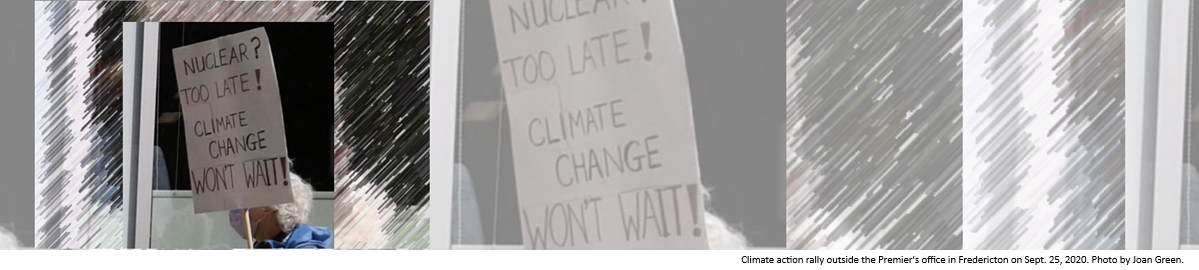
Both the provincial and federal government are handing millions in public funds to a UK company to extract plutonium at Point Lepreau in New Brunswick. Read the update on this story, published in July by the Bulletin of the Atomic Scientists, HERE.
Here’s some facts Trudeau and Higgs are not sharing:
One of the projects will extract plutonium at Point Lepreau that can be used to make nuclear weapons, say US nuclear experts.
The waste from the new reactors will be MORE radioactive per kilo than the existing waste at Point Lepreau. It will be stored next to the Bay of Fundy.
Building the new reactor sites will create hundreds of tons of radioactive concrete, radioactive steel and other radioactive materials that cannot be recycled. NB taxpayers will be responsible for the disposal costs.
Concerned? Show your support for our Coalition. Join hundreds of New Brunswickers: Sign up, put your name on our website and receive our monthly newsletter. Visit our members page for the list of people and groups in our Coalition and sign-up sheet to become a champion.
The Conservation Council of New Brunswick (CCNB) wrote to federal Environment Minister Wilkinson with concerns about New Brunswick’s proposed regulation Phasing Out of Coal-fired Electricity Generation – Climate Change Act. CRED-NB was among the many groups endorsing the CCNB letter. Our concerns regard the use of equivalency agreements when Canada is promoting its commitment to phasing out coal-fired electricity by 2030 within the Powering Past Coal Alliance. Read the letter HERE.
CRED-NB has been working with Nuclear Waste Watch and a national committee of civil society groups. We have ID’d key points we want to see in the new federal policy:
No importing of radioactive waste from other countries
No plutonium extraction (reprocessing or pyro-processing) of radioactive fuel waste
Canada needs an independent agency, arms-length from government and industry, to oversee radioactive waste management and decommissioning
Radioactive waste should NOT be abandoned; policy should direct perpetual care and monitoring
Government and industry must be open and transparent in the management of radioactive waste and its transportation
Indigenous peoples and all Canadians have a right to access information, to engage in decision-making, and to know the risks
Our core Coalition member, the Sierra Club Canada Foundation Atlantic Chapter, is a registered charity. They are part of our Coalition’s campaign to stop the development of SMRs (SMNRs) in New Brunswick. Click HERE to find out more about donating to CRED-NB and receiving a tax credit.
CRED-NB co-hosted two panel presentations about the proposed nuclear projects this week, drawing hundreds of attendees from New Brunswick, across Canada and the US and Europe.
Videos of both presentations were published today by the NB Media Co-op. Access them here.
Selon des groupes environnementaux : Le Fonds canadien pour les énergies propres ne doit pas financer la pollution nucléaire!
Le français suit
OTTAWA, April 7, 2021 – Citizen and environmental groups urge the federal government not to fund polluting nuclear technologies in the upcoming budget, and to instead invest in truly clean and renewable energy solutions across the country.
The federal government recently handed $70.5 million to private-sector companies in Ontario and New Brunswick to develop their designs for more nuclear reactors. Critics have denounced these handouts and are demanding that the federal government ban polluting small modular reactor (SMR) technology from the Clean Energy Fund announced in the Throne Speech.
In a brazen greenwashing move, the federal government is working closely with the nuclear industry and the provinces of Ontario, New Brunswick and Saskatchewan to rebrand nuclear power as “clean energy.” The uranium fuel chain has left a devastating legacy of radioactive poisons in First Nations and small communities across Canada.
By their very nature, nuclear reactors create irradiated fuel that contains numerous radioactive materials that remain hazardous for hundreds of thousands of years. The process that the nuclear industry terms “recycling” only involves transferring these radioactive materials to other waste streams. No place exists on the planet that is licensed to safely store these “forever” pollutants.
More than 100 public interest, Indigenous and civil society organizations from coast to coast have endorsed a public statement against federal funding for new nuclear energy, including the United Church of Canada, Canadian Association of Physicians for the Environment, Canadian Federation of University Women, Climate Action Network and Équiterre.
The groups are in solidarity with the Assembly of First Nations, the Chiefs of Ontario, and the Wolastoq Grand Council in New Brunswick that have all demanded that the federal government stop funding new nuclear reactors and cease generating more radioactive waste.
Critics say that the $70.5 million spent by the feds so far would be a ‘drop in the bucket’ compared to the huge needs of private sector nuclear start-up companies. Their reactor designs could cost up to $2 billion to develop to a point when these could be licensed for construction.
The designs proposed are based on unproven technologies and will take a decade or more to develop, with no guarantee that they will be commercialized successfully. They will not be ready in time to help meet Canada’s climate targets for reducing greenhouse gas emissions.
A recent report by Canada’s Green Budget Coalition, made up of 25 leading environmental organizations, states that: “The federal government should provide no support for the development of SMRs.” The Coalition says that indirect subsidies for the nuclear industry – such as protection from accident liability, and sharing waste responsibilities with the private sector – also do not belong in the federal budget.
Leading international bodies have also remarked on the dismal outlook for SMRs and nuclear power in general in climate action. For instance, the 2020 World Nuclear Industry Status Report analysis found that investing in new nuclear energy is too slow to address the climate crisis, compared to investing in proven renewable energy and energy efficiency.
QUOTES
“Funding new nuclear technologies is a bad investment – a waste of both time and money, and it delays real climate action. Canadians want affordable energy that does not pollute the environment. Why would we invest in unproven technologies that, if they ever work, will cost two to five times more than building proven renewables? Indigenous leaders across the country oppose building nuclear reactors or storing nuclear waste in their territories because it contains ‘forever’ radioactive poisons.” – Prof. Susan O’Donnell, Coalition for Responsible Energy Development (CRED) in New Brunswick
“Investing in unproven, next-generation nuclear technology is a dirty, dangerous distraction from tackling the climate crisis. Why are we locking Canadians into high cost electricity and accepting the liability for the nuclear industry when we have safe, renewable technology that is scalable now? We need to rapidly transition to a carbon-free electricity system, not invest in an energy system that we already know is plagued with delays and cost overruns. New nuclear simply can’t get us there on time.” – Kerrie Blaise, Northern Services Legal Counsel,Canadian Environmental Law Association
“Several studies have shown that electricity from small modular reactors will be more expensive than electricity from large nuclear power plants, which are themselves not competitive in today’s electricity markets. There is no viable market for small modular reactors, and even building factories to manufacture these reactors would not be a sound financial investment.” – M. V. Ramana, School of Public Policy and Global Affairs, University of British Columbia
– 30 –
Media contacts:Kerrie BlaiseNorthern Legal Counsel, CELA Email: kerrie@cela.caTel: 416-960-2284 ext 7224 Susan O’DonnellCoalition for Responsible Energy Development (CRED), New BrunswickTel: 506-261-1727Susanodo.unb@gmail.comEva Schacherl, Media LiaisonTel: 613-316-9450evaschacherl@gmail.com ————————————————-Pour diffusion immédiate
Selon des groupes environnementaux : Le Fonds canadien pour les énergies propres ne doit pas financer la pollution nucléaire!
OTTAWA, le 7 avril 2021 – Une coalition de citoyens et de groupes environnementaux demande que le gouvernement canadien exclue les technologies nucléaires polluantes de son prochain budget. « Mieux vaut investir dans les énergies vraiment propres et renouvelables », disent-ils.
Le gouvernement fédéral a récemment versé 70,5 millions$ à des entreprises privées de l’Ontario et du Nouveau-Brunswick pour les aider à mettre au point de nouvelles générations de réacteurs nucléaires. Les critiques dénoncent ces dons et demandent que le gouvernement du Canada exclue les petits réacteurs modulaires (PRM) des technologies admissibles au Fonds pour l’énergie propre annoncé dans le discours du Trône.
Dans un geste d’écoblanchiment évident, le gouvernement fédéral a fait alliance avec l’industrie nucléaire et avec les provinces de l’Ontario, du Nouveau-Brunswick et de la Saskatchewan pour déguiser l’énergie nucléaire en « énergie propre ». L’uranium utilisé comme combustible a laissé un héritage dévastateur de poisons radioactifs dans les Premières nations et dans les petites collectivités, partout au Canada.
Le combustible irradié des réacteurs nucléaires contient inévitablement de nombreux éléments radioactifs qui vont rester dangereux pendant des centaines de milliers d’années. Le « recyclage » dont parle l’industrie nucléaire se résume à détourner ces éléments radioactifs vers d’autres types de déchets. Aucun endroit sur la planète n’a jamais été autorisé à stocker ces polluants « immortels » en sécurité.
Plus de 100 groupes militants, autochtones ou citoyens de tout le Canada, ont approuvé une déclaration publique contre le financement fédéral des futures technologies nucléaires, dont l’Église Unie du Canada, l’Association canadienne des médecins pour l’environnement, la Fédération canadienne des femmes diplômées des universités, le Climate Action Network et Équiterre.
Les groupes sont solidaires de l’Assemblée des Premières Nations, des Chefs de l’Ontario et du Grand Conseil Wolastoq au Nouveau-Brunswick qui ont tous exigé que le gouvernement fédéral cesse de financer de nouveaux réacteurs nucléaires qui vont toujours produire davantage de déchets radioactifs.
Les critiques disent que les 70,5 millions de dollars dépensés jusqu’à présent par le gouvernement fédéral ne seraient qu’une goutte d’eau par rapport aux énormes besoins des industries nucléaires en démarrage dans le secteur privé. La mise au point de chaque nouveau réacteur pourrait coûter jusqu’à 2 milliards de dollars avant même qu’on commence à les construire.
Les concepts mis de l’avant se basent sur des technologies qui n’ont pas fait leurs preuves et dont la mise au point exigera au moins une décennie, sans aucune garantie de pouvoir ensuite les commercialiser avec succès. Ils ne seront pas prêts à temps pour contribuer à l’atteinte des objectifs climatiques du Canada en matière de réduction des gaz à effet de serre.
Un rapport récent de la Coalition du budget vert, composée de 25 organisations environnementales canadiennes, déclare que: « Le gouvernement fédéral devrait cesser d’appuyer le développement des PRM. » Selon cette Coalition, les subventions indirectes à l’industrie nucléaire – comme la déresponsabilisation de l’industrie en cas d’accident et le partage des risques avec le secteur privé en matière de déchets – ne devraient pas non plus figurer au budget fédéral.
Des organismes internationaux ont également souligné les perspectives d’avenir lamentables des PRM et de l’énergie nucléaire dans les interventions climatiques. Le 2020 World Nuclear Industry Status Report a conclu que l’investissement dans ces nouvelles technologies nucléaires agira trop lentement pour contrer la crise climatique, par rapport à un investissement similaire dans les énergies renouvelables qui ont fait leurs preuves.
CITATIONS
«Le financement de nouvelles technologies nucléaires est un mauvais investissement – une perte de temps et d’argent, et il retarde une action climatique réelle. Les Canadiens veulent une énergie abordable qui ne pollue pas l’environnement. Pourquoi investirions-nous dans des technologies non éprouvées qui, si jamais elles fonctionnent, coûteront de deux à cinq fois plus cher que les énergies renouvelables éprouvées? Les dirigeants autochtones de tout le pays s’opposent à la construction de réacteurs nucléaires et au stockage de déchets nucléaires sur leur territoire parce qu’ils contiennent des poisons radioactifs «immortels».
– Pr Susan O’Donnell, Coalition pour un développement énergétique responsable (CRED) au Nouveau-Brunswick
« Le fait d’investir dans une technologie nucléaire de nouvelle génération qui n’a pas fait ses preuves n’est qu’une distraction sale et dangereuse dans la lutte contre la crise climatique. Pourquoi opterions-nous pour une électricité plus coûteuse et pourquoi accepterions-nous les risques de l’industrie nucléaire alors que nous disposons d’une technologie renouvelable sûre et prometteuse dès maintenant? Nous devons passer rapidement à un système électrique sans carbone, plutôt que d’investir dans un système énergétique en proie à des retards et à des dépassements de coûts. Le nouveau nucléaire ne peut tout simplement pas nous y amener à temps. »
– Kerrie Blaise, conseillère juridique des Services du Nord, Association canadienne du droit de l’environnement
« Plusieurs études ont démontré que l’électricité des futurs petits réacteurs modulaires sera plus chère que l’électricité des grandes centrales nucléaires, qui ne sont elles-mêmes pas compétitives sur le marché actuel de l’électricité. Il n’existe pas de marché viable pour les petits réacteurs modulaires. Même la construction d’usines de fabrication de ces réacteurs ne serait pas un investissement financier solide. »
– M. V. Ramana, École des politiques publiques et des affaires mondiales, Université de la Colombie-Britannique
– 30 –
Contacts pour les médias :Ginette CharbonneauRalliement contre la pollution radioactive514-246-6439ginettech@hotmail.caGilles ProvostRalliement contre la pollution radioactive514-773-5704artscience@videotron.ca
Today CRED-NB published its first edition of Nuclear Reaction (April 2021)! We are excited to announce that the digital edition is available for download from our Nuclear Reaction page, here. You are welcome to print and distribute this edition. We are publishing and distributing 2,400 hard copies across New Brunswick. If you would like to distribute copies in your community, contact us: info@crednb.ca
The nuclear industry has conveniently taken the “N” for “nuclear” out of SMR.
It refers to them as SMRs: small modular reactors. Ask yourself, why don’t they want you to know these reactors are nuclear? By the way, they’re not so small either.
It’s a bargain!
The industry is suggesting that this is the time to get in on the ground floor, claiming SMRs are going to take off and make everyone rich. The reality is these SMRs will be oodles more expensive than any of the other energy options on the table. In order to be cost effective, a company would need to sell thousands of their particular model (there are over a 100 SMR designs currently in competition). The only SMR actually built so far is on a barge off the shores of Russia and very little is known about it. The most advanced SMR in the West is the NuScale project. Nearly $1 billion and 15 years later, it’s still not built! Nuclear energy is in decline globally, and has been for some time. The SMRs are a desperate attempt to sell a technology that will soon be obsolete.
So what if it’s a bad investment for nuclear companies, it’s their problem not ours, right?
Nope. These companies can’t get Wall Street or Bay St. to ante up, so governments are the ones investing millions of dollars on designs for SMR prototypes and providing billions in loan guarantees. You know where that money comes from? You, the taxpayer. In 2018, the New Brunswick government spent $10 million on two SMR designs (ARC and Moltex), and in February 2021, it promised $20 million to further develop the ARC design. The federal government just announced it will invest $50 million in SMR development (Moltex) for New Brunswick. Wouldn’t you rather your tax dollars go to health care, supporting local businesses, reducing class sizes in schools, or even renewable energy?
OK, but we need to ramp up nuclear energy because of climate change. Afterall, nuclear energy doesn’t produce CO2 emissions.
Hah, that’s a funny one! It presumes a fairy godmother waved her magic wand and produced an SMR out of thin air. These things take years and years to build, and the carbon involved in constructing them is huge—not to mention the mining of materials such as uranium, which destroys forests and ecosystems, poison water, and more. Also, we need climate action NOW. Assuming commercial SMRs even work (the technology is still unproven), the best case scenario is there might be one SMR up and running in New Brunswick in the early 2030s. If that’s NB’s road to GHG reductions, it’ll already be too late.
But we need electricity! Wind and solar are intermittent sources of energy. What if the wind doesn’t blow or the sun doesn’t shine!?
Hmm, like that’s going to happen in Atlantic Canada. Normally, there’s more wind in the colder months and more sun in the hotter months, so they tend to balance themselves out. Nevertheless, for additional and more reliable energy, we need only look next door to Quebec for hydro power. Plus, battery storage is getting better and cheaper all the time. Right now in California, Tesla and PG&E are building the largest battery storage facility ever constructed. It will be able to dispatch 730 MW of energy to the electrical grid—that’s more than Point Lepreau in New Brunswick currently does (660MW). The project was announced last summer (2020) and it’s almost completed. Imagine, an energy project that’s on time and on budget. It could be a first for New Brunswick (and Atlantic Canada)! Nova Scotia Power is also testing small Tesla batteries in homes to store energy generated from solar panels.
There haven’t been any Chernobyl or Fukushima-like nuclear energy disasters in recent years, so the technology must be safer now, right?
Wrong again. The two companies hoping to develop SMRs for New Brunswick are start-ups—they’ve never built a nuclear reactor! Their experimental SMR designs involve creating even more concentrated forms of deadly liquid nuclear waste. Did you know that nuclear waste remains toxic for thousands of years? Who wants that in their backyard? Furthermore, the SMRs structures themselves, like the Point Lepreau reactor, remain radioactive when their lifespans are over. Who is going to be responsible for cleaning up that mess? New Brunswick taxpayers!
Yes, but the government will make sure these SMRs are safe.
No, I’m afraid not. In fact, the federal government has exempted all SMRs built on existing reactor sites from undergoing environmental assessments. Guess where the SMR(s) will be built in New Brunswick? At Point Lepreau! Therefore, SMRs built in NB won’t undergo any environment assessments by the federal government. New Brunswickers will be guinea pigs, at the mercy of the nuclear power industry that’s desperate to make a sale.
Hmm, yes, but NB really needs jobs and these SMRs will provide new and hopefully good paying jobs.
Sure, New Brunswickers need good jobs, but why should they be given this kind of ultimatum? Ask yourself, who is telling you that nuclear energy will create lots of jobs, and that they’re the only new jobs available—and why? Is it the nuclear industry, along the federal and provincial governments, which are trying to dig themselves out of previous bad investments in nuclear technology? Let’s look at the facts, not the BS: solar energy creates 4–5 times as many jobs as nuclear energy. The US Bureau of Labor Statistics forecasts that “America’s two fastest-growing jobs through 2026 will be solar installer (105% growth) and wind technician (96% growth)” (Forbes, 2019). In case you’re wondering, nuclear jobs didn’t even register high enough to make the charts.
Point Lepreau is already a highly secure facility but SMRs would require even more armed security.
That’s because they involve extracting plutonium from Point Lepreau’s existing reactor to make new fuel for the SMRs. Plutonium is the primary nuclear explosive material in the world’s arsenals of nuclear weapons. A derivative of uranium that does not exist in nature, plutonium is created inside every nuclear reactor fuelled with uranium. Up until now, Canada has never extracted plutonium in a commercial nuclear reactor. Why not? Two reasons: 1) it is highly dangerous and polluting to “open up” the used nuclear fuel in order to extract the desired plutonium; and 2) extracting plutonium creates an opportunity for civilian trafficking in highly dangerous materials that can be used by enemy governments, criminals, or terrorists to make powerful nuclear weapons without the need for terribly sophisticated or readily detectable infrastructure. So, more risk, more danger, more security, more cost.
New Brunswick is F@#ked!
Yup, unless people speak up loud and clear and tell the nuclear industry, the NB government, and Federal government that nukes are not welcome here.
The day after the federal taxpayer $50.5 million gift to Moltex Energy for their new nuke in New Brunswick, CRED-NB’s Susan O’Donnell was interviewed by the CBC morning radio programs in Fredericton, Moncton and Saint John. Listen to the interviews below.
Radioactive waste must be kept isolated from all living things.
March 18, 2021
Extracting plutonium from used nuclear fuel? We need to know the risks
ROTHESAY, NB – The Coalition for Responsible Energy Development in New Brunswick (CRED-NB) urges the governments of Canada and New Brunswick to tell New Brunswickers and all Canadians about the risks of the Moltex experiment announced today.
The announcement this morning in Saint John by federal Minister Dominic LeBlanc and New Brunswick Premier Blaine Higgs was missing key information. Extracting plutonium from nuclear waste was banned in Canada by former Prime Minister Pierre Elliot Trudeau. Today the ban has been lifted, marking a significant departure in Canadian policy.
We wonder: why did Prime Minister Justin Trudeau lift the ban that Trudeau senior imposed? Where is the peer review of this proposed research that addresses the significant weapons proliferation concerns as well as environmental risks? Was ANY peer review conducted of the research proposed for New Brunswick before granting $50.5 million today to Moltex Energy to develop their technology?
Our research has found that it is highly dangerous and polluting to “open up” the used nuclear fuel in order to extract the desired plutonium. Extracting plutonium creates a civilian traffic in highly dangerous materials that can be used by governments or criminals or terrorists to make powerful nuclear weapons without the need for terribly sophisticated or readily detectable infrastructure.
Why was our province selected for this dangerous and controversial process? What are the implications for New Brunswickers and our natural environment?
In 2019, after intensive lobbying by the nuclear industry, the new federal Impact Assessment Act project list excluded new nuclear projects at Point Lepreau. These new nuclear projects are exempt from a federal impact assessment. Who will answer our questions?
“Because these projects planned for the Bay of Fundy are exempt from a federal Impact Assessment, there are no opportunities for the public to learn and have their say about this risky, expensive and speculative process. Pyroprocessing has never been done anywhere before. Why was New Brunswick chosen for this dangerous experiment?” said Ann McAllister, member of CRED-NB.
“It’s shameful and irresponsible that both the Canadian and New Brunswick governments are supporting the extraction of plutonium from CANDU used fuel without reviewing the environmental and weapons proliferation challenges,” continued McAllister. “We have grave concerns about the risks being introduced to our Bay of Fundy and surrounding communities with no public discussion or debate in the Parliament of Canada or the Legislative Assembly of New Brunswick,” she added.
The federal government has not yet developed a comprehensive policy and strategy for the oversight and management of our existing legacy of toxic radioactive waste, let alone the new types of deadly radioactive waste that would be generated by this new project.
“Some of the most contaminated sites on Earth – Hanford in the US, Sellafield in the UK, Mayak in Russia – are the result of large-scale reprocessing of used nuclear fuel that released dangerous long-lived radioactive material into the environment,” said Dr. Gordon Edwards, a nuclear expert who provides technical advice to CRED-NB.
The Coalition for Responsible Energy Development in New Brunswick (CRED-NB) advocates for our province to be a leader in Canada in the development of innovation in renewable energy and nuclear decommissioning technologies.
CRED-NB supports the Wolastoq Grand Council Resolution opposing nuclear energy and nuclear waste on traditional Wolastoq territory, here.
CRED-NB has endorsed the public statement signed by more than 100 public interest, Indigenous and civil society groups across Canada calling for an end to federal funding for new nuclear reactor development, here.
-30-
For more information:
David Thompson
Spokesperson, CRED-NB
H: 506-635-1297
Technical expert: Dr. Gordon Edwards
President, Canadian Coalition for Nuclear Responsibility
ccnr@web.ca
cell: 514-839-7214
CCNR office: 514-489-5118
Coalition for Responsible Energy Development in New Brunswick (CRED-NB)
PO Box 4561 • Rothesay • New Brunswick • Canada • E2E 5X3