Webinar Feb. 7: How to intervene in a CNSC hearing (Point Lepreau)

JOIN US!
All are welcome to join us. No expertise or former experience necessary!
WHEN: February 7, 2022, from 6-7:30pm (AST)
WHERE: Virtually via Zoom. Registration is required.
WHO: CELA’s Theresa McClenaghan, Kerrie Blaise and Krystal-Anne Roussel

The Canadian Environmental Law Association and the Coalition for Responsible Energy Development in New Brunswick invite you to an evening workshop on February 7 where the public will have an opportunity to learn about the Canadian Nuclear Safety Commission’s intervention process.

NB Power is asking for a 25-year licence renewal for its Point Lepreau nuclear generating station. Learn more about your environmental rights and how citizens and groups can submit a written or oral ‘intervention’ at the hearing. Intervening before the Commission is the public’s way of participating in decisions relating to the licensing of Canada’s nuclear facilities

This workshop will prepare members of the public to provide written and oral comments to the Commission for the licence renewal hearing of NB Power’s Point Lepreau Nuclear Generating Station.

Comments to the Commission are due March 28, 2022. Part 2 of the hearing is scheduled to occur virtually May 11 – 12, 2022 via Zoom. (Part 1, on Jan 26 th involves only presentations by NB Power and CNSC staff.)

News from the US: First “advanced” reactor licence application dismissed

The US Nuclear Regulatory Commission (NRC) dismissed the licence application for the “first advanced reactor … with full private funding backing for a commercial project” because the application lacked information on safety and other key issues. Read the story HERE.

CRED-NB’s take on this story above: In contrast to the US nuclear regulator, In Canada we have the Canadian Nuclear Safety Commission (CNSC) with a much more accommodating process: pre-licence “Vendor Design Reviews” or VDRs. The VDRs certify that the nuclear proponents applying for a licence understand the CNSC licence process. It’s impossible to “fail” this largely instructional/advisory process, intended to assist in the subsequent licence process.

Passing a pre-licence VDR allows the nuclear proponent (the company with a design for a so-called small modular nuclear reactor) to promote the “success” of its design. The multiple nuclear companies currently in the CNSC’s VDR process are in serious competition for private investors. Advertising their “success” in a VDR gives the impression that the CNSC has approved the design’s technical readiness, which is not the case.

The pre-licence VDR seems to promote the industry in Canada. An expert in the US has said that the pre-licence VDR process makes Canada like a tax haven for start-up SMR companies. Judging by the high number of SMR start-ups in Canada from other countries, this is believable.

The CNSC publishes the executive summary of the VDR reports on its website. The conclusion section of each summary identifies safety and performance aspects of the proposed design needing more information for the next VDR phase. All of the VDR reports we’ve read end with the astonishing phrase: “Notwithstanding the above, these issues are foreseen to be resolvable and will be followed up on in future phases of the VDR.”

How can a regulator state that core issues related to novel nuclear reactor safety and performance “are foreseen to be resolvable”? A logical conundrum!?

Climate change will not wait for miracles

This message was sent today to the Canadian Nuclear Association, the lobby for the nuclear industry in Canada:

The top five reasons why the Coalition for Responsible Energy Development in New Brunswick (CRED-NB) is not buying your small modular nuclear reactor (SMR) fantasies

5. With 120 other groups across Canada, CRED-NB signed a public statement calling SMRs a “dirty, dangerous distraction” from climate action. Nobody believes we can build an SMR that could produce electricity commercially in this country before 2040. It will take that long to turn the SMR drawings into engineered designs that could safely contain the dangerous radioactive gasses nuclear energy emits. If an SMR is actually built, only then will we learn if it works to produce energy. Climate change will not wait to see if miracles can happen. The U.N. Intergovernmental Panel said we have until 2030. Let’s not waste the time we have.

4. Your proposal to build a machine in New Brunswick to extract plutonium from spent nuclear fuel is dodgy at best. You call it “recycling,” a ridiculous label for a process that could only re-use less than one percent of the spent nuclear fuel. The scientists that we consulted say your process would produce new and dangerous forms of liquid nuclear waste and be wildly expensive. Nine eminent US non-proliferation experts have raised alarms about your plan, calling for a weapons non-proliferation international review. We also want a review, but you are dismissing our concerns. What are you afraid of?

3. Nuclear power is the most expensive way to produce electricity. New Brunswick Power’s Point Lepreau Nuclear Generating Station – the only operational nuclear power plant outside Ontario in Canada ­­– is a financial fiasco. The New Brunswick Auditor General reported that the Lepreau nuclear plant is responsible for $3.6 billion of NB Power’s $4.9 billion debt. That’s a nuclear debt load of more than $4,500 on every person, including babies, living in our province. Enough already!

2. We want renewable energyNew research by the Conservation Council of New Brunswick found little social licence for SMRs in our province. Most New Brunswickers want our electricity to come from clean, renewable sources that do not create radioactive waste. Building new nuclear reactors will take billions of public dollars and many decades. We want the subsidies to go instead toward wind and solar energy, energy efficiency, and building the Atlantic Loop to share electricity across the region. We can build, right now, a robust electricity transmission system that will meet our needs. We want sustainable infrastructure connected to renewable energy generation, not nuclear white elephants.

1. We read peer-reviewed research. Our opposition to SMRs is based on science. You – a lobby for the nuclear industry – are responsible for stoking the climate crisis over many decades, since the beginning of commercial nuclear power generation, with your empty promises of electricity too cheap to meter. Now you’re promising to help end the climate crisis! We’re not buying it anymore. We have science on our side, and the science says SMRs are a waste of time and money and the nuclear industry is dying for good reason. Let’s all get real and work together for the next two decades on an orderly wind-down of nuclear power in New Brunswick and across Canada. Let us introduce you to some of the many scientists who have charted a path to net zero without new nuclear. You can put your SMR fantasies to rest – it’s time.

NB Power applies for a 25 Year licence to operate the Point Lepreau nuclear facility to 2047

NB Power has applied to the Canadian Nuclear Safety Commission for renewal of the licence to operate the Point Lepreau Nuclear Generating Station (PLNGS) for 25 years, from 2022 to 2047.  The nuclear reactor at Point Lepreau is currently scheduled for shut-down in 2040, when it will reach its end of life.

The Coalition for Responsible Energy Development-New Brunswick (CRED-NB) will make a joint intervention with the Canadian Environmental Law Association (CELA) to oppose the 25-year licence and argue for a shorter licence period.  CRED-NB will provide updates on the process on its website, and we invite all New Brunswickers interested in nuclear issues to check back for updates.  

On January 26 2022, Part 1 of the CNSC’s public hearings, will be conducted virtually.  NB Power will present its case for the licence and the CNSC will provide recommendations.  The virtual format for the hearing, which will be webcast publicly, raises concerns about public engagement.  Will New Brunswickers be aware of the licence process and have their interests represented? 

The hearing will happen in two parts.  Part 2 on May 4 and 5 of 2022 will be held in New Brunswick (likely Saint John), or virtually if COVID restrictions require.

CRED-NB and CELA believe that 25 years is far too long for a licence period.  It is well in excess of past operating licence renewals in Canada, that ranged from 2 to 5 years.  After the rebuild (refurbishment) of the Lepreau reactor (from March 2008 to November 2012), PLNGS and was expected to operate safely for another 30 years.  Many unscheduled shut downs have, however, been required since that time, including 40 days in February-March of 2021.  

NB Power and the government of New Brunswick are also supporting the development of new nuclear reactors (so called SMRs) as well as a nuclear waste reprocessing/plutonium extraction facility on the site, within a decade. 

CRED-NB wrote to the CNSC requesting specific arrangements to adequately address those concerns (letter below).

November 23, 2021
To: Marc Leblanc, Canadian Nuclear Safety Commission
From: Gail Wylie, Coalition for Responsible Energy Development -New Brunswick 

Request for the CNSC to publicize the Part 1 Hearing of NB Power PLNGS Licence Renewal 

The Coalition for Responsible Energy Development – New Brunswick (CRED-NB), will be preparing a request to intervene in the NB Power Point Lepreau Nuclear Generating Station (PLNGS) licence renewal.  We understand that the Part 1 public hearing will be virtual and that the purpose is for NB Power to present its case, and for CNSC staff to present their recommendations. 

As the CNSC will be considering a request from NB Power for an unprecedented licencing term of 25 years, we need the New Brunswick public to have maximum awareness of this hearing.  Part 1 of the hearing may also reveal issues to be responded to by public intervenors in Part 2 of the hearing in May.

We are requesting that the CNSC conduct a broad public information campaign, with advertisements in New Brunswick media as well as a social media campaign.  The rationale:

  • New Brunswick residents (and NB Power ratepayers) must be informed about the hearing and their options to participate, well in advance of the hearing date.  
  • The CNSC must provide notice of the hearing beyond online means (i.e., via print and radio); alternative arrangements must be made for New Brunswickers who are without access to personal internet.
  •  Building public trust in the CNSC’s process and decisions is crucial, and ensuring that there is awareness of the upcoming hearing is a preliminary first step.  
  • Wide public observation of the CNSC Part 1 proceedings will begin to address concerns about transparency with regard to the CNSC and NB Power, that have persisted over the 38-year history of the PLNGS. 
  • NB Power’s presentation needs to be accessible for the public to observe and evaluate, so that New Brunswickers can understand the licence renewal process and repercussions on our energy future.  

Critically, citizens who have a direct interest in the proceeding, must be provided the procedural rights to effectively participate in all parts of the hearing.  CRED-NB requests that the CNSC exercise its discretion to further public participation and build trust in the process through meaningful involvement. 

Thank you for considering our request to mount a broad awareness campaign including alternatives for those without internet access.  We look forward to your response and trust that the CNSC appreciates our genuine concerns where New Brunswickers have so much at stake. 

13 New Brunswick groups ask PM Trudeau for a moratorium on new nuclear

More than 70 groups, including 13 in New Brunswick, sent a letter to Prime Minister Trudeau asking for a moratorium on new nuclear energy to be included in the mandate letters of the new cabinet, expected to be named next week.

October 4, 2021
The Right Honourable Justin Trudeau
Prime Minister of Canada
80 Wellington St. 
Ottawa, ON K1A 0A2
by email: justin.trudeau@parl.gc.ca

A moratorium on federal funding for nuclear expansion: mandate letters to cabinet

Dear Prime Minister:

Congratulations on your recent re-election. As organizations working tirelessly to protect the environment and seek solutions to the critical issue of climate change, we reflect the concerns of millions of Canadians and work as allies with Indigenous nations.

We request your attention to a critical matter of human health, environmental and intergenerational importance. In your action on climate change, we ask your government to refrain from supporting nuclear infrastructure expansion, including so-called small modular nuclear reactors (SMRs); support would delay addressing climate change because speculative SMR technology would be ready too late and pose safety and security risks. We strongly recommend that your office consult the latest expert analysis conducted by independent researchers, available in the 2021 World Nuclear Industry Status Report.

We are aware that your government is dedicating $8 billion to a “Net Zero Accelerator” fund in addition to other funding envelopes which could be available to develop new nuclear reactor prototypes. SMRs should not be eligible for any government funding, and certainly not as part of a climate action plan.

During the previous term, your government undertook no consultation whatsoever with environmental and citizen groups about new nuclear development. Further, funding or plans for new nuclear development were not included in the 2021 election platform of the Liberal Party. Your government does not have a mandate from Canadians to spend public funds on new prototype nuclear reactors, especially considering the danger and risks of the wastes generated and nuclear weapons proliferation. 

The public’s voice cannot be ignored. In 2018, the Assembly of First Nations issued resolution 62/2018 calling for the Government of Canada to cease funding and support of the Small Modular Nuclear Reactors program. This past year, 120 civil society, public interest and Indigenous groups signed a public statement sent to you and all Members of Parliament; this statement expressed their opposition to federal funding for SMRs, explaining why the proposed new nuclear reactors are “dirty, dangerous distractions” from genuine climate action.

As your government deliberates on its priorities, in the mandate letters of the ministers responsible for Health Canada; Environment and Climate Change Canada; Global Affairs Canada; Natural Resources Canada; Innovation, Science and Economic Development Canada and the regional development agencies; and Transport Canada, we urge you to include a specific direction to:

  • Institute a moratorium on funding for new prototype nuclear reactors, for uranium enrichment plants and for used-fuel reprocessing installations, until long term safe monitored containment from the biosphere can be implemented for intermediate and high-level radioactive wastes.
  • Strengthen the independence, transparency and accountability of the Canadian Nuclear Safety Commission and ensure all SMRs are subject to full impact assessments (now, appallingly, most proposed SMRs are exempt from federal impact assessment).
  • Ensure that the government and the nuclear industry engage in free, prior, and informed consent with Indigenous peoples on all nuclear development, including modular nuclear reactors, uranium mines and radioactive waste facilities.
  • End the expansion of Class 1 nuclear facilities in residential areas; the unsuccessful $1 billion attempt to clean up Port Hope, in Ontario, indicates the financial and health risks associated with locating nuclear facilities in proximity to housing and schools.
  • Institute a high-level review, including by international experts, of both the nuclear weapons proliferation and environmental implications of the federally funded plutonium-extraction project currently underway at Chalk River, in Ontario, and planned for development on the Bay of Fundy in New Brunswick.
  • Ban the import of nuclear waste and nuclear material, i.e., plutonium from dismantled nuclear warheads.

In addition, we demand that you make public the expected cost of your government’s plan to develop new nuclear reactor prototypes including the cost of long-term management of their radioactive wastes.

We request your response as soon as possible using the following email address: info@crednb.ca

Sincerely,

Groups undersigned:

Action Climat Outaouais (QC) Réal Lalande, président

Action Environnement Basses-Laurentides (QC) Lucie Massé, porte-parole

Algonquin Eco Watch (ON) Mike Wilton, President

Anishinabek Nation (ON) Mel Hardy, Regional Deputy Grand Council Chief

Artiste pour la paix (QC) Pierre Jasmin, Leader

Association québécoise de lutte contre la pollution atmosphérique (QC) André Bélisle, président

Bonnechere River Watershed Project (ON) Dr. Kathryn Lindsay, Chair/Program Volunteer

Canadian Environmental Law Association (ON) Theresa McClenaghan, Executive Director and Legal Counsel

CARN – Citizens Against Radioactive Neighbourhoods (ON) Jane Scott, founding member

Citizens Resistance At Fermi Two (CRAFT) (Michigan) Jesse Deer In Water, Community Organizer

Citoyens au Courant de Vaudreuil-Soulanges (QC) Katherine Massam, porte-parole

ClimateFast (ON) Lyn Adamson, Co-Chair

Coalition for a Clean Green Saskatchewan (SK) David Geary, researcher

Coalition for a Nuclear Free Great Lakes (Michigan) Michael J. Keegan, representative

Coalition for Responsible Energy Development (NB) Ann McAllister, David Kersey, Lise Auffray, members

Concerned Citizens of Manitoba (MB) Anne Lindsey, representative

Concerned Citizens of Renfrew County and Area (ON) Ole Hendrickson, PhD, Researcher

Conservation Council of New Brunswick (NB) Louise Comeau, PhD, Director of the climate change and energy program

Council of Canadians (ON) Mark Calzavara, National Water Campaigner

Council of Canadians – Fredericton Chapter (NB) Gail Wylie, representative

Council of Canadians – Kitchener-Waterloo (ON) Marilyn Hay, Chair

Council of Canadians – Ottawa Chapter (ON) Eva Schacherl, Volunteer

Council of Canadians – Saint John Chapter (NB) Leticia Adair, Contact

Eau Secours (QC) Rébecca Pétrin, directrice générale

Église Unie Westmount Park (QC) Rév. Neil Whitehouse, président du Conseil d’administration

EOS Eco-Energy (NB) Amanda Marlin, Executive Director

Équiterre (QC) Émile Boisseau-Bouvier, Analyste, politiques climatiques et transition écologique

Extinction Rebellion New Brunswick (NB) Doug Swain, PhD, Organiser

Friends of the Earth Canada (ON) Beatrice Olivastri, CEO

GMob (GroupMobiliation) (QC) Michel Jetté, co-fondateur

Green Coalition/Coalition Verte (QC) Gareth Richardson, President

Greenspace Alliance of Canada’s Capital (ON) J. P. Unger, Director

Inter-Church Uranium Committee Educational Cooperative (SK) Michael Poellet, President

International Physicians for the Prevention of Nuclear War Canada (BC) Jonathan Down, President 

MiningWatch Canada (ON) Jamie Kneen, Co-manager

Mouvement Vert Mauricie (QC) Patrick Rasmussen, président

National Council of Women of Canada (ON) Patricia Leson, President

NB, not Nuclear – Le NB, non le nucléaire (NB) Erik LeBrun, Founder/Administrator 

New Brunswick Anti Shale Gas Alliance (NB) Roy Ries, Coordinator and Jim Emberger, Spokesperson

Northwatch (ON) Brennain Lloyd, Project Coordinator

Old Fort William Cottagers’ Association (QC) Johanna Echlin, M.Ed, Spokesperson

Ontario Clean Air Alliance (ON) Angela Bischoff, Director

PEI (Epekwitk) Fridays for Future Climate Action Group (PE) Tony Reddin, co-coordinator

Peterborough Pollinators (ON) Jo Hayward-Haines, co -founder

Pontiac Environment Protection (QC) Deborah Powell, President

Port Hope Community Health Concerns Committee (ON) Faye More, Chair

Prairie Institute for Human Ecology (SK) Lynn Wesley Oliphant, Coordinator

Prevent Cancer Now (ON) Meg Sears, PhD, Chair

Project Ploughshares Saskatoon (SK) Linda Murphy, secretary/treasurer

QuAppelle Valley Environmental Association (SK) Randall Lebell, Communications

Ralliement contre la pollution radioactive (QC) Ginette Charbonneau et Gilles Provost, porte-paroles

RAVEN project at the University of New Brunswick ( NB) Susan O’Donnell, PhD, Leader

Regroupement des citoyens de Saraguay (QC) Sylvia Oljemark, présidente

Regroupement écocitoyen de Sainte-Marthe-sur-le-Lac (QC) Sylvie Rose Clermont, présidente

Regroupement vigilance hydrocarbures Québec (QC) Philippe Duhamel, coordonnateur général

Religieuses de Notre-Dame-du-Sacré-Coeur (NB) Ida Nolan, Murielle Duguay, Thérèse Belliveau, Membres de la Communauté

Réseau québécois des groupes écologistes (QC) Chantal Levert, coordonnatrice générale

San Luis Obispo Mothers for Peace (California) Jane Swanson, President

Saskatoon Peace Coalition (SK) Michael Murphy, Chairperson

Sierra Club Canada Foundation (ON) Gretchen Fitzgerald, National Programs Director

Sierra Club Québec (QC) Isabelle Sawyer, co-présidente

Solar Island Electric Inc. (PE) Darcie Lanthier, President

St. Stephen Environmental Group (NB) Chris Corey, Director 

STOP THE HOGS (SK) Elaine Hughes, Administration

Sustainable Development Association & Indigene Community (QC) Douglas Jack, President

Sustainable Energy Group (NB) Sam Arnold, Co-ordinator

Unifor Québec (QC) Raymond Thibert, président Comité de santé, sécurité et environnement d’Unifor

United Church of Canada (NB) Kent Gibbons, Minister

VANA (Veterans Against Nuclear Arms) Saskatoon (SK) Colin Clay, Member

WaterCareAllies (First United Church, Westboro) (ON) Judith Miller, Coordinator

Women’s Healthy Environments Network (ON) Cassie Barker, Executive Director
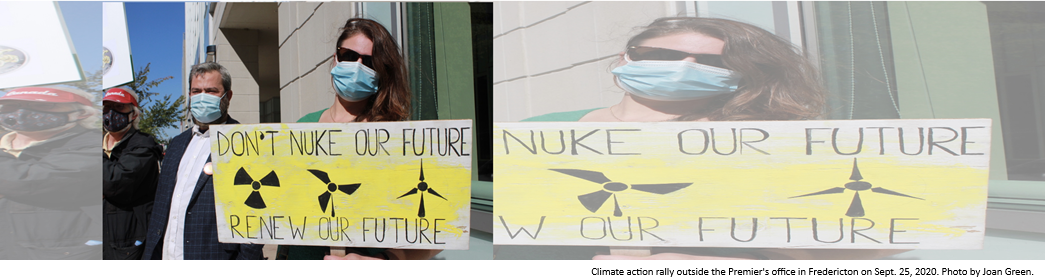
Rally Sept. 24 – Climate Emergency: This is Not a Drill

Rally for a safe climate and equitable world! Stand in solidarity with people most affected by the climate crisis.

Friday, September 24 @noon at the New Brunswick Legislature in Fredericton.

Optional: 10:30am meet at Conserver House, 180 St. John Street (near the Legislature) to make signs.

Hear from climate activists, Indigenous land defenders, youth, scientists, trade unionists, energy policy experts and elected representatives on what a just energy transition looks like for Fredericton, New Brunswick, Canada and beyond.

“Not a drill”: Fredericton rally to call for climate justice

Extinction Rebellion New Brunswick and partner organizations, including environmental groups and labour unions, invite everyone to assemble at the New Brunswick Legislature in Fredericton on unceded Wolastoqiyik territory on September 24 at noon to demand that all levels of government take immediate and effective action on the climate emergency that respects climate justice.

Participants are asked to wear masks and stand six feet apart in a visual display of safety and solidarity with everyone around the world affected by climate change and the global pandemic.  

“Our Indigenous Elders have told us for decades that humans have lost their way by neglecting to uphold the original teachings on how to respect and live in balance with Mother Earth. Hence, we are presently in a state of emergency facing global climate disasters and it will only worsen if we as humans don’t stop the greed of corporations and colonial governments,” says Wolastoqewi Grand Chief spasaqsit possesom – Ron Tremblay. 

“Climate justice goes beyond advocating for renewable energy, recognizing that injustice is linked to social, economic, and political systems and that climate change has its roots in capitalism, colonialism, the patriarchy and other systems of oppression,” says Susan O’Donnell, one of the climate rally organizers and lead researcher with the RAVEN project at the University of New Brunswick. 

With New Brunswick refusing to close the Belledune coal plant in 2030 as part of Canada’s transition off coal, advocates for a just energy transition point to the need to include all affected workers and communities in climate solutions and future economic planning. 

“Now is the time to be talking about a just energy transition for workers in the fossil fuel and nuclear sectors and their communities in New Brunswick as well as in Colombia where NB Power has been sourcing coal from the Cerrejón coal mine since the 1990s. It’s not the time to keep yesterday’s fuel sources like coal and nuclear on the table,” said Tracy Glynn, one of the rally organizers and who has worked with Colombian coal miners and affected community members to tell their stories for more than a decade. 

“The coal burned in Belledune comes from Colombia where its extraction is linked to the forced displacement and starvation of Indigenous Wayuu and Afro-Colombian farmers and children and repression of coal miners and unionists. Climate justice is migrant justice. It’s reproductive justice. It’s housing justice,” says Glynn. 

Climate activists, Indigenous land defenders, youth, scientists, trade unionists, energy policy experts, and elected representatives will share their thoughts on what a just energy transition looks like for Fredericton, New Brunswick, Canada and beyond. Ron Tremblay, the Wolastoq Grand Chief, David Coon, MLA for Fredericton South, Fredericton Mayor Kate Rogers, Lois Corbett, Executive Director of the Conservation Council of New Brunswick, and Danny Legere, President of the New Brunswick Federation of Labour are among the speakers.

This rally is supported by Extinction Rebellion New Brunswick, Council of Canadians Fredericton Chapter, Council of Canadians Saint John Chapter, Coalition for Responsible Energy Development in New Brunswick (CRED-NB), Conservation Council of New Brunswick, CUPE NB, Fredericton Club of the Communist Party of Canada, Leap4wards Saint John, New Brunswick Anti-Shale Gas Alliance (NBASGA), New Brunswick Federation of Labour, NB Media Co-op, No One Is Illegal Fredericton, RAVEN, Reproductive Justice NB and Solidarité Fredericton.

All social justice, environmental and climate action groups are invited to endorse this rally. To add your name to our event coalition, contact: fredericton.solidarity@gmail.com.

For more information, contact Tracy Glynn, 506 440-5592,  fredericton.solidarity@gmail.com.

Bloc Québécois shows real leadership on the nuclear file

The Bloc Québécois (BQ) could block the Liberal Party’s chance of forming a majority government in Canada. Both the Liberals and the Conservatives are pushing new nuclear development (so-called small modular nuclear reactors).

Over the past year, the BQ has issued three media releases opposing the new nuclear reactors. Now their platform has underlined the party’s commitment to stopping these dirty, dangerous distractions from climate action. Bravo!

Check out this website or read the statement signed by more than 100 public interest, Indigenous and civil society groups, including CRED-NB, explaining why we are opposing new nuclear development, HERE.

Plutonium in New Brunswick? The facts Trudeau and Higgs are not telling us

Screen Shot 2020-08-22 at 12.56.58

Both the provincial and federal government are handing millions in public funds to a UK company to extract plutonium at Point Lepreau in New Brunswick. Read the update on this story, published in July by the Bulletin of the Atomic Scientists, HERE.

Here’s some facts Trudeau and Higgs are not sharing:
  • One of the projects will extract plutonium at Point Lepreau that can be used to make nuclear weapons, say US nuclear experts.
  • The waste from the new reactors will be MORE radioactive per kilo than the existing waste at Point Lepreau. It will be stored next to the Bay of Fundy.
  • Building the new reactor sites will create hundreds of tons of radioactive concrete, radioactive steel and other radioactive materials that cannot be recycled. NB taxpayers will be responsible for the disposal costs.

See more information about nuclear energy on this website.

Concerned? Show your support for our Coalition. Join hundreds of New Brunswickers: Sign up, put your name on our website and receive our monthly newsletter. Visit our members page for the list of people and groups in our Coalition and sign-up sheet to become a champion.

CRED-NB endorses CCNB letter opposing NB’s plan to delay ending coal power

The Conservation Council of New Brunswick (CCNB) wrote to federal Environment Minister Wilkinson with concerns about New Brunswick’s proposed regulation Phasing Out of Coal-fired Electricity Generation – Climate Change Act. CRED-NB was among the many groups endorsing the CCNB letter. Our concerns regard the use of equivalency agreements when Canada is promoting its commitment to phasing out coal-fired electricity by 2030 within the Powering Past Coal Alliance. Read the letter HERE.