NBASGA’s vision for a renewable energy future for New Brunswick

CRED-NB champion, the New Brunswick Anti-Shale Gas Alliance (NBASGA), put its comments on the energy transition up on its website, HERE.

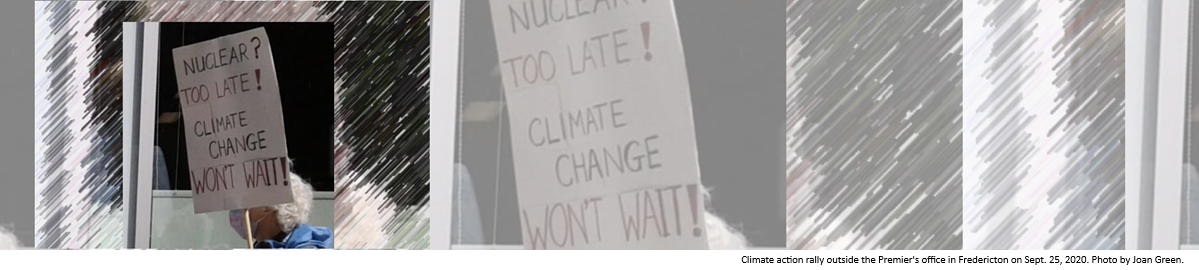
In its submission, NBASGA argues that renewable energy – primarily wind and solar – should be the focus of the lion’s share of New Brunswick’s energy investments. It is the only option that checks all the strategic focus boxes, including affordability, energy security and reliability. Similar to CRED-NB, NBASGA believes that new nuclear energy is not needed. The submission quotes the latest research showing that SMRs are too expensive, slow and risky.

Video: Indigenous Leaders Raise Concerns About Nuclear Waste

Indigenous leaders from New Brunswick and Ontario held a media event in Ottawa today to share their concerns about nuclear waste on their homelands. Participants:
Chief Hugh Akagi, Peskotomuhkati Nation in Canada
Chief Ron Tremblay, Wolastoq Grand Council
Mississauga First Nation Councillor Peyton Pitawanakwat
Elizabeth May, Co-Leader of the Green Party of Canada, MP for Saanich-Gulf Islands
Facilitator: Kim Reeder, consultant, Passamaquoddy Recognition Group

Watch the video HERE.
Read the media release HERE.

The APTN covered the story, HERE.

We the Nuclear Free North petition – sign by May 3

Our friends in Northern Ontario are asking allies across Canada to sign their Parliamentary petition that closes on May 4. Their petition page with the link to sign is HERE.

The petition calls upon the Government of Canada to require the Nuclear Waste Management Organization (of which NB Power is a member) to demonstrate that it has the consent of residents and communities, including First Nations and Treaty Organizations, along the transportation route and in the region of and downstream of the candidate site for the proposed deep geological repository for the burial of all of Canada’s high-level nuclear waste (including the waste generated by the Point Lepreau nuclear reactor in New Brunswick).

Nuclear dinosaurs roam New Brunswick and Ontario

‘Nuclear Dinosaurs’ Roam New Brunswick, Ontario as ‘Jurassic’ Partnership Looms. The Energy Mix published an article by CRED-NB core member Susan O’Donnell and Mark Winfield from York University about the looming partnership between NB Power and Ontario Power Generation to jointly operate the Point Lepreau nuclear reactor. “Each is stuck in the past, the only two utilities left in Canada operating nuclear power reactors. Both have rejected modern, efficient, decentralized, nimble, distributed energy systems powered by low-cost renewable energy in favour of keeping their aging CANDU reactors alive. Together, the two lumbering public utilities plan to bring forth a revitalized New Brunswick Point Lepreau reactor, hoping their new progeny will reverse its previous ailing fortunes.” Read the article HERE.

Article in The Bulletin of the Atomic Scientists

One of the proposed small reactors for New Brunswick plans to reprocess (extract the plutonium from) the used nuclear fuel from the Point Lepreau reactor to make new reactor fuel. CRED-NB core member Susan O’Donnell co-wrote an article with Gordon Edwards about the history of reprocessing in Canada leading up to the Moltex project in New Brunswick. The article, ‘Nuclear industry wants Canada to lift ban on reprocessing plutonium, despite proliferation risks’ was published by The Bulletin of the Atomic Scientists, link HERE.

Radioactive demolition

CRED-NB is a member of the SMR Information Task force that publishes regular bulletins send to federal and provincial legislators. This month the topic is radioactive small modular reactors.

Every nuclear reactor, large or small, runs on neutrons. The core of the reactor is swarming with these subatomic projectiles. Each time a neutron splits a uranium atom, energy is released and radioactive waste is created.

Indeed, the broken fragments of uranium atoms are fiercely radioactive materials called “fission products”, and they accumulate in the fuel. Used nuclear fuel is millions of times more radioactive than unused fuel because of the fission products. This “high-level radioactive waste” must be isolated from the environment for many millennia.

But some neutrons penetrate into the structural materials of the reactor, making them radioactive too. When a stray neutron is absorbed by a non-radioactive atom, that atom is often “activated” –it becomes radioactive.

When a nuclear plant is dismantled, much of the rubble is too radioactive to be reused for other purposes. Such radioactive “decommissioning waste” must be kept out of the food chain and the water for tens of thousands of years.

Read the full bulletin HERE.

Radioactive Waste Policy in Canada – where did it go? [webinar]

The year 2023 saw many developments for nuclear waste policy and governance. For an update on last year and discussion of what we can expect in the year ahead, join this webinar on Thursday, February 29 at 8pm Atlantic. Speakers include Susan O’Donnell from CRED-NB who will talk about policy related to reprocessing radioactive fuel waste in Canada. Other speakers are:

  • Theresa McClenaghan, Canadian Environmental Law Association, speaking about Canada’s Radioactive Waste Policy
  • Ole Hendrikson, Concerned Citizens of Renfrew County and Area and Sierra Club Canada Foundation, speaking about an Integrated Strategy on Radioactive Waste

The event registration is HERE.

This event is part of a series on nuclear waste organized by Northwatch and Nuclear Waste Watch.

Tripling nuclear power: public relations fairy dust

SMR Information Task Force bulletin #6

The federal government recently endorsed two similar nuclear fantasies.

This month, Natural Resources Canada published a statement endorsing a plan to work with other countries to “advance a global aspirational goal of tripling nuclear energy capacity from 2020 by 2050.”

The global nuclear declaration attracted endorsements from only 22 countries. In contrast, the official COP28 pledge to triple renewable energy by 2030 was signed by 123 countries and adopted by consensus as the official COP declaration.

Earlier, in 2023, the Canadian energy regulator projected a tripling of Canadian nuclear generation capacity by 2050.

Why is Canada engaged in a nuclear fantasy?

Click HERE to read the rest of the bulletin.

CRED-NB is a member of the SMRs Information Task force, a national coalition of groups that issues regular bulletins about so-called small modular nuclear reactors. These bulletins are sent to all MPs in Ottawa and provincial representatives in several provinces, including New Brunswick.

SMRs and plutonium

SMR Information Task Force bulletin #5

Plutonium is the stuff from which nuclear bombs are made. It is created as a byproduct of nuclear fission. Plutonium resides in the fiercely radioactive used fuel assemblies discharged from nuclear reactors. Any method for extracting plutonium from used fuel is called reprocessing.

Moltex Energy, a U.K. start-up, plans to extract plutonium from used fuel produced by the Point Lepreau reactor on the Bay of Fundy. Moltex needs plutonium to fuel its proposed reactor. It hopes to export the technology.

Another company in New Brunswick, ARC Clean Energy, wants to reprocess the used fuel from its proposed reactor, designed to “breed” plutonium.

Ottawa has given the two companies almost $60 million, and New Brunswick more than $30 million, to develop their technology.

Click HERE to read the rest of the bulletin.

CRED-NB is a member of the SMRs Information Task force, a national coalition of groups that issues regular bulletins about so-called small modular nuclear reactors. These bulletins are sent to all MPs in Ottawa and provincial representatives in several provinces, including New Brunswick.