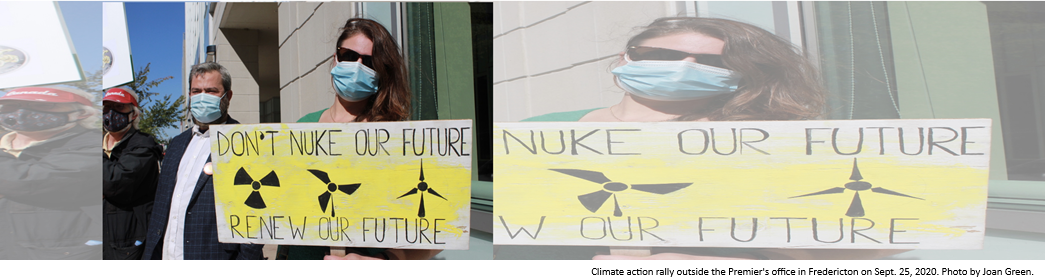
Fueling the money pit: new nuclear reactors for New Brunswick

Both the PCs and Liberals are fuelling the latest money pit – untested, unproven new nuclear reactor designs. If they spend enough money, and if they work, the new reactors will generate the most expensive electricity!

The cost of nuclear energy is going way up while renewable solar and wind energy costs are going way down. Spending public funds on more nuclear is a bad investment.

The provincial government and NB Power have already given $30 million to two start-up companies from the UK and the US to develop plans for new reactors at Lepreau. The Trudeau government has given more than $50 million more.

NB Power is almost $5 billion in debt. More than $3 billion of that is from its massive cost over-runs on the refurbishment of its Point Lepreau Nuclear Generating Station and the expensive ongoing repairs to the nuclear plant since then. And we want more?

Around the world, nuclear power has a long history of massive expenses and repairs coming in millions over-budget. And governments – we, the taxpayers – always end up with the bill.

The Point Lepreau nuclear debt is driving up electricity costs in New Brunswick. Now both the PC party and the Liberal party are promoting MORE nuclear power for New Brunswick.

Building the two proposed new nuclear reactors in New Brunswick will cost more than $2 billion each. Billions more will be required from future taxpayers in New Brunswick to clean up and store the radioactive concrete, steel, and other materials left when the  new reactors are decommissioned.

Why should we leave a financial mess along with the dangerous radioactive materials risking the health of our children and grandchildren and many, many more generations of New Brunswickers in future?

Good question, so why are both the PCs and the Liberals promising to give New Brunswick more nuclear energy?

The nuclear industry is desperate to survive and lobbying hard for public handouts. Because the new reactors have no customers, there is no business case so the banks will not finance the development unless the government guarantees the loans.

Better still for the nuclear industry, the plan seems to just hand over billions in public cash, in non-repayable grants!

The nuclear industry lobby group  representative in New Brunswick has another job: he is the Vice-President Nuclear of NB Power and the highest-paid public servant in the province. A circular, bottomless money pit!

Non-proliferation experts send letter of concern over New Brunswick nuclear project

The Moltex project is in the news again! A second open letter to the Prime Minister from US non-proliferation experts, saying that the claims of Moltex Energy are misleading. Who to believe? A UK company recently established in Saint John to access public funding for its nuclear project, or US experts with no conflict of interest? The US experts say that the Moltex claims are wrong. The article is in the National Observer today, you can read it HERE.

New Brunswick project: Will Canada remain a credible nonproliferation partner?

Today the Bulletin of the Atomic Scientists published an article by CRED-NB’s Susan O’Donnell and collaborator Gordon Edwards, president of the Canadian Coalition for Nuclear Responsibility. The article focuses on the letter sent in May by nine US scientists and non-proliferation experts, countering misleading claims made by Saint John’s Moltex Energy about their proposed project to extract plutonium from used nuclear fuel. You can read the article HERE.

We Can Achieve 80% Renewables in New Brunswick by 2030

The Conservation Council of New Brunswick (CCNB) published a statement today stating that New Brunswick can achieve 80% renewables by 2030. The statement links to a factsheet.

The statement is responding to the CBC report about the plans by the government of New Brunswick government to keep the Belledune coal-energy plant operating into 2040.

CCNB has created a letter-writing tool to speak out for renewables. Use it to send your letter to the provincial minister of energy Mike Holland, cc to Premier Higgs. It’s at the end of this page.

Is nuclear winning? [video]

Metta Spence, a sociologist, has been running the “Project Save the World” for Peace Magazine. They produce a video almost every weekday on YouTube with people discussing different global issues. This week, CRED-NB’s Susan O’Donnell appeared with Metta, M.V. Ramana from the University of British Columbia, and Doug Saunders from the Globe & Mail. Metta titled the video: Is Nuclear Winning? You can view the video here.

Who is pushing the new nuclear reactors and why should we care?

CRED-NB member Dr. Susan O’Donnell participated in a panel event last week organized by the Ontario Clean Air Alliance (OCAA). The panel followed a discussion with the maker of the film: The Atom: A Love Affair.

The OCAA organized a Canadian screening of the film that is open for another week, till July 11. It’s a high-quality feature length film that explains the history of nuclear power, including interviews with key people involved. Tickets cost $10. Access to the film is HERE.

At the panel, Susan spoke about SMNRs: who is pushing them and why should we care? You can view the video of her presentation on YouTube (11 minutes):

US Experts to Trudeau: Your Nuclear Dream May Turn Nightmare

RAVEN researcher Susan O’Donnell, a member of CRED-NB, was interviewed in an article published today by The Tyee. The story was prompted after nine US experts sent a letter to Prime Minister Trudeau about the nuclear weapons proliferation implications of the federal government’s support for the Moltex project in New Brunswick. You can read it here.

Peskotomuhkati chief unhappy about nuclear reactor testing on his traditional territory

The APTN published a story this week about the nuclear projects planned for Point Lepreau on the Bay of Fundy.

In the article, Chief Hugh Akagi “says he hasn’t been formally consulted – but has been to a presentations put on by NB Power about the SMR project. He says he is unlikely he’ll ever give it his support.”

“Until I can have an assurance that the impact on the future is zero,” says Akagi, “I don’t want to 100 years, 200 years is still seven generations. I want zero impact.”

You can read the full APTN article HERE.