Do not sacrifice Canada’s climate progress

Canadians are heading to the polls on April 28th, in a moment when we’re facing the human & economic costs of both climate change and the trade war.

Climate Action Network and civil society groups from coast to coast are calling on parties not to sacrifice Canada’s climate progress to Donald Trump’s destructive agenda during this election & beyond.

See Climate Action Network full statement with quotes from civil society by clicking HERE. CRED-NB has signed onto this statement.

Pour le français cliquez ici.

Don’t backslide on fossil fuel projects

By Jim Emberger – Special to Brunswick News – Published February 20, 2025

Threatening times, with rapidly changing events, inevitably produce two things. Public and media attention becomes focused on the turmoil and pace of immediate concerns, and longstanding issues, regardless of importance, are set aside.

Secondly, some corporate or financial interests will attempt to use the distraction to push profiteering schemes, especially unpopular ones.  This is sometimes known as “disaster capitalism.”

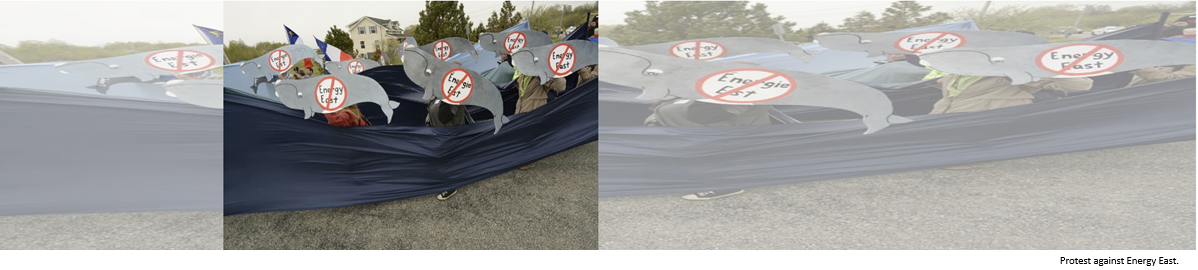
We see this today as Canada’s fossil fuel producers, and their political and media allies, respond to Donald Trump’s tariff threats by re-introducing the ideas of the Energy East bitumen pipeline and various shale gas/LNG projects.

These projects are now cloaked in patriotism, with their proponents cynically counting on the public’s anxiety and patriotic fervour to cloud its memory of the legitimate economic and environmental grounds for rejecting the projects originally.

Read more

Jim Emberger is the spokesperson for the New Brunswick Anti-Shale Gas Alliance (NBASGA). NBASGA is a CRED-NB Champion.

Webinar: Beyond the Shock Doctrine: Conversation on Tariffs, Climate and Solidarity

2025-02-12 Beyond the Shock Doctrine Webinar - horizontal

CRED-NB is a member of Climate Action Network Canada (CAN-Rac) and we signed and shared a statement about how we should respond to tariffs. Now CAN-Rac has organized a webinar, Beyond the Shock Doctrine: Conversation on Tariffs, Climate and Solidarity, Wed. Feb. 12 @ 8 PM Atlantic.

Hosted by Climate Action Network Canada and the UBC Centre for Climate Justice, this conversation will feature Naomi Klein, Co-Director of the Centre for Climate Justice, Syed Hussan, Executive Director of the Migrant Workers Alliance for Change, and Lubicon Cree advocate Melina Laboucan-Massimo, founder and Executive Director of Sacred Earth Solar.

Join this important conversation by registering here. Spots are limited!

Ahead of Trump’s tariffs, civil society groups call for a response that puts people first and builds resilience

CRED-NB is a member of Climate Action Network Canada. Today we joined with groups across the country to issue a statement: Ahead of Trump’s tariffs, civil society groups call for a response that puts people first and builds resilience.

Trump’s first weeks in office have been marked by appalling decisions across numerous fronts—from exiting the Paris Agreement, to mass Immigration and Customs Enforcement raids and arrests, to attacking trans rights—as well as by the looming spectre of punitive tariffs.

Protecting Canadians during a second Trump administration and its wake will require bold measures from our federal and provincial leaders. But the response from some Canadian politicians so far has been alarming: we have seen increased militarism at the border and scapegoating migrants, backpedalling on climate commitments, and cynical ploys to entrench fossil fuel dependence. Read the full statement HERE.

COP 29: A band-aid on a bullet wound

CRED-NB is a member of Climate Action Network Canada, an organization representing more than 100 groups across the country advocating for climate action. Several Climate Action Network Canada staffers participate every year in the annual Conference of the Parties (COP) meetings to find global solutions to the climate crisis. Today Climate Action Network Canada issued a media release calling COP 20 “a band-aid on a bullet wound.” The media release HERE, includes a bullet-point summary of the highlights as well as quotes from other members of the network who attended COP 29.

End Canada’s thermal coal exports!

CRED-NB is a signatory with 35 other groups, led by Ecojustice, to a letter to Prime Minister Trudeau asking for a ban on thermal coal exports. Thermal coal is one of the dirtiest fossil fuel contributors to climate change. Coal power generation is the largest single source of global greenhouse gas emissions and one of the first fossil fuels whose use must be phased out.

Ending coal power will also improve the health of millions around the world. Air pollution generated by coal kills more than 800,000 people each year. The extractive origins of thermal coal can also have devastating impacts on lands, waters and local communities, including impacts on Indigenous nations and their inherent rights, including fishing, hunting and gathering.

Read or download the letter HERE.

Climate events in Fredericton and Sackville – July 31 + August 1

It’s time to discuss the ways to tackle climate change at the grassroots level, the role of local communities in shaping Canada’s energy policies, and strategic actions and innovative solutions to cap emissions and accelerate our transition to cleaner energy.”

That describes events planned in Fredericton and Sackville by Sierra Club Canada and local hosts. The events are open to everyone.

Sierra Club Canada – Atlantic Chapter are good friends of CRED-NB. Stop-SMRs in NB is a Sierra Club Canada campaign. July 31 in Fredericton and August 1 in Sackville you can meet Sierra Club national programs director Gretchen Fitzgerald and local climate advocates and experts.

In Fredericton @6 PM Wednesday, July 31, at the Charlotte St. Arts Centre Gretchen will co-host with Moe Qureshi of the Conservation Council of New Brunswick (CCNB).

In Sackville @11:30 AM Thursday, August 1, at the Sackville Commons at 18 Lorne St., Gretchen will co-host with Tantramar Alliance Against Hydro-fracking (TAAHF) and include speaker Sabine Dietz (CLIMAtlantic).

Pizza will be served in Fredericton • in Sackville there will be “an assortment of light snacks prepared by ‘Ketchup With That’ kitchen.” Organizers asked anyone planning to go to respond to the Facebook event page: Fredericton page HERE • Sackville page HERE

Atlantic environmental groups ask for sustainable, affordable, and healthy energy system

CRED-NB is one of 28 organizations signatory to a letter to the Atlantic premiers and the Prime Minister today (April 10) asking for action to ensure a healthy energy system. The letter says it’s time for Atlantic Canada to halt new LNG, shale, and fossil fuel projects and put the well-being of our people and our region before short-term corporate gains. Read the full letter HERE.

Waste: To burn or not to burn?

CRED-NB is one of 40 groups across Canada signatory to a Call to Action issued today against burning waste. We must stop burning things to produce energy!

From the media release:

While Canada is set to host the next round of the Global Plastics Treaty negotiations April 23-29, Canadian groups are raising an alarm about the expansion of waste incineration across the country. Dubbed “waste-to-energy” (WTE) by industry, burning waste through methods like incineration, gasification and pyrolysis is a practice that would undermine federal climate, plastics, and waste management policies.

“Canada has goals to end plastic pollution and stop climate change. That means we must close the door to polluting and wasteful garbage incineration,” said Karen Wirsig, Plastics Senior Program Manager at Environmental Defence. “Incineration poses real risks to the environment and human health. Plus, garbage is not a clean or ‘renewable’ energy source and incinerators have been found to emit more greenhouse gasses per unit of electricity than fossil fuels.”

Read the full media release with the list of signatories HERE.

Electricity from burning wood pellets is a scam

In its recent Energy Plan, the New Brunswick government proposed that the NB Power Belledune power plant should switch from burning coal to burning wood pellets. The federal government has mandated that all coal-fired electricity plants stop burning coal by 2030.

However generating electricity from forest-based biomass is a false climate solution. Burning wood for heat is one thing but burning it to generate electricity is incredibly inefficient.

Research has shown that burning wood pellets generates more carbon emissions at the smokestack than coal. It also creates many toxic particles harmful for the health of surrounding communities.

Two years ago, more than 500 scientists sent an open letter to world leaders calling on them to not burn forests to make energy.

How can governments get away with claiming that biomass-generated electricity is renewable and carbon neutral? It’s a scam.

International carbon accounting rules state that carbon losses from forest harvesting have to be reported in the land sector section of the carbon audit for the country where the trees were cut.

Every time a hectare of forest is cut, that counts as a reduction of forest carbon uptake. The harvested forest wood, if it’s burned, can’t be reported as a CO2 emission, because that would be counting it twice.

So the country or province that burns trees reports that as zero carbon emissions. That means that producers can treat biomass as being equivalent to zero emissions technologies, like wind and solar. Scam!

Scientists and environmental activists everywhere are lobbying hard for constraints to be put on the use of forest wood as a renewable fuel.

In November, CRED-NB signed a letter to federal Energy and Natural Resources minister Wilkinson, with 26 other climate groups across Canada, calling on the federal government to take immediate action on biomass. These are some of our demands:

• Work with other levels of government to ensure forests are off-limits to wood pellet production for export.

• End all subsidies to the utility-scale wood pellet industry

• Redirect funding to Indigenous land use, stewardship or restoration projects and real climate solutions such as wind and solar power.

• Support value-added jobs that provide more substantial and stable economic opportunities
locally.

• Encourage utilities to take a public stance against burning forest biomass as an energy replacement for burning coal.

• Advocate on the international stage for an update to carbon accounting mechanisms that closes loopholes which falsely represent industrial logging and utility-scale exported biomass as carbon neutral.