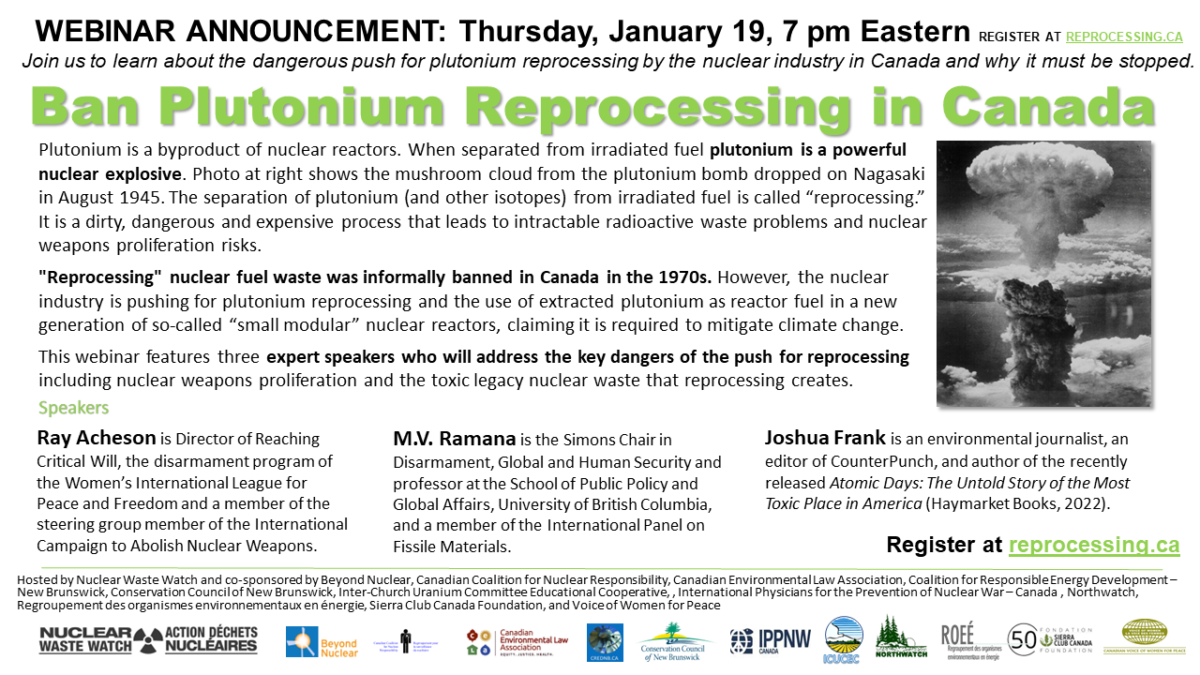
Canada’s new policy on radioactive waste must ban reprocessing

For immediate release 

December 15, 2022 

Canada’s new policy on radioactive waste must ban plutonium reprocessing 

Ottawa – Today, a national alliance of civil society organizations launched a campaign to formally demand that Canada includes a ban on plutonium reprocessing in its radioactive waste policy. 

Canada will release its policy on managing radioactive waste in early 2023. A draft policy for public comment released in February 2022 says that “deployment of reprocessing technology… is subject to policy approval by the Government of Canada” but does not take a clear position opposing this technology. 

Reprocessing is a means of extracting plutonium from nuclear fuel waste. Reprocessing is highly contaminating, practiced in only a few countries, and linked to nuclear weapons proliferation. 

Dozens of public interest groups and Indigenous communities participated in the federal radioactive waste policy consultations, and more than 7,000 Canadians submitted letters including a demand that the policy bans reprocessing. In March 2022, Nuclear Waste Watch’s Radioactive Waste Review Group released An Alternative Policy for Canada on Radioactive Waste Management and Decommissioning that forbids plutonium reprocessing. 

Commercial plutonium reprocessing has never been carried out in Canada. The limited reprocessing at the federal government’s Chalk River Laboratory to supply nuclear weapons material for the American military ended in the 1960s but left a legacy of nuclear contamination in Canada. 

Canada has had an informal ban on reprocessing since the 1970s, following India’s testing of its first nuclear weapon made using plutonium from a “peaceful” nuclear reactor, a gift from Canada. 

However, the informal ban was breached in 2021 when the federal government granted $50.5 million to a New Brunswick company, Moltex Energy, to develop its technology to reprocess fuel waste from existing CANDU reactors with the intent of exporting the technology globally. The government also granted more than $1.2 billion to Canadian Nuclear Laboratories (CNL) to expand their nuclear research centre at Chalk River to include a laboratory for research that could include plutonium reprocessing. 

Yet a 2016 CNL report found no business case for reprocessing CANDU fuel, in part “due to its low fissile content,” and the associated costs and risks. The CNL report also stated that reprocessing would “increase proliferation risk.”

That finding about reprocessing and nuclear weapons proliferation is replicated in a major report released in November 2022 by a U.S. National Academy of Sciences expert panel. The panel reached consensus that the proposed Moltex reprocessing technology does not provide “significant proliferation resistance.” 

“By reversing its ban on plutonium reprocessing and supporting the development of new reprocessing technology intended for export, Canada seems to be blundering into another dangerous proliferation miscalculation,” says Dr. Gordon Edwards, President of the Canadian Coalition on Nuclear Responsibility. Edwards cited the three letters written to Prime Minister Justin Trudeau by U.S. nonproliferation experts warning of the dangers of developing reprocessing technology in Canada. 

“Reprocessing intensely radioactive spent fuel presents more opportunities for release of radionuclides than leaving spent fuel in thick metal or concrete casks,” says Brennain Lloyd, spokesperson for Northwatch. “Reprocessing does not reduce the need for radioactive waste storage or long-term management. After reprocessing, the remaining material will be in several different waste forms, and the total volume of nuclear waste will have been increased by a factor of 20 or more.” 

“Are the policy-makers reading the research or only the nuclear industry’s sales and promotional materials?” asks Dr. Susan O’Donnell, spokesperson for the Coalition for Responsible Energy Development in New Brunswick. “There is no legitimate reason to support technologies that create the potential for new countries to separate plutonium and develop nuclear weapons. The government should stop supporting this dangerous technology.” 

-30- 

For more information: 

The Ban Plutonium Reprocessing campaign website: reprocessing.ca 

Nuclear Waste Watch: nuclearwastewatch@gmail.com 

Gordon Edwards, PhD, President, Canadian Coalition for Nuclear Responsibility
Phone: 514-489-5118 Email: ccnr@web.ca 

Brennain Lloyd, spokesperson, Northwatch 
Phone: 705-493-9650 Email: brennain@northwatch.org 

Susan O’Donnell, PhD, spokesperson, Coalition for Responsible Energy Development in New Brunswick
Phone: 506-261-1727 Email: info@crednb.ca 

Belledune Port SMR announcement: Public relations stunt to promote a “dirty, dangerous distraction from climate action”

For immediate release – November 28, 2022

Belledune Port SMR announcement: Public relations stunt to promote a “dirty, dangerous distraction from climate action”

Today the Belledune Port Authority in New Brunswick announced plans to use an ARC-100 reactor to generate heat and power for industrial users at the port. NB Power is planning to apply for a site licence to develop the ARC-100 reactor at Point Lepreau on the Bay of Fundy.

The Belledune Port’s announcement today is a public relations stunt to make it appear that there is business interest in so-called “small modular nuclear reactors (SMRs),” an attempt to attract the government and private investment that the nuclear industry desperately needs to survive.

SMRs like the ARC-100 will need massive amounts of public funding to develop. The proponents have not released any costs, but the government of Saskatchewan has estimated it will cost $5 billion to develop an SMR. To date there have been almost no private investors for SMRs because they are such a bad investment.

The Coalition for Responsible Energy Development in New Brunswick (CRED-NB) has endorsed a public statementsigned by more than 120 public interest groups across Canada calling an SMR a “dirty, dangerous distraction from climate action.”

The ARC-100 – a small modular nuclear reactor is a “first of its kind,” according to the Canadian Nuclear Safety Commission. The reactor design includes using liquid sodium as a coolant, a material that reacts violently on contact with air or water. Sodium-cooled nuclear reactors have never been successfully commercialized. 

Proponents claim the ARC-100 is “proven technology,” exaggerated claims based on the performance of a research reactor that operated under laboratory conditions for almost 30 years, relying on a highly enriched type of fuel that would never be allowed for use in a commercial plant.

In other countries, attempts to commercialize sodium cooled reactors have resulted in major environmental cleanups that were more costly than the original reactor builds.

The first commercial sodium-cooled reactor in the US (the Fermi-1 plant, just outside Detroit) suffered a partial meltdown and was quickly scrapped. The book “We Almost Lost Detroit” describes in detail what went wrong. In other countries, sodium fires and erratic performances led to the abandonment of sodium-cooled reactors in France (the Superphénix), in Japan (the Monju breeder), in Germany (the Kalkar plant), and in Scotland (the Dounreay reactor).

All of these shut-down sodium-cooled reactors have proven to be far more expensive to decommission than they were to build. The costs of radioactive decontamination are extraordinarily high in every single case.  Although the laboratory reactor (the EBR-2) was shut down permanently in 1994, scientists are still – 27 years later – trying to extract the sodium metal from the highly radioactive used metallic fuel so that that high-level radioactive waste material can be safely disposed of without causing underground explosions due to sodium-water or sodium-air reactions, as happened in the case of the Dounreay reactor.

Environmental lawyer Kerrie Blaise says: “The nuclear industry is promoting a nuclear fantasy to attract political support while purging past failures – like cost overruns and project delays – from public debate. Before Canada invests any public dollars in this yet-to-be-developed technology, they must fully evaluate the costs of nuclear spending and liabilities associated with the construction, oversight, and waste of this novel technology.”

The federal Impact Assessment Agency of Canada (IAAC) has begun reviewing a formal designation request from CRED-NB to subject the ARC-100 for a full federal Impact Assessment (IA). A final decision from the Minister of Environment, Steven Guilbeault, is anticipated by January 2, 2023.

Despite the potential for significant environmental impacts, the ARC-100 SMR is currently exempt from IA. This exemption (due to successful nuclear industry lobbying) means there would be no comprehensive examination of the project’s risks, costs and benefits, and downstream impacts before a decision is made to site one in New Brunswick. 

“As early as June of next year, NB Power wants a licence from the nuclear regulator to proceed with site prep for the ARC nuclear reactor. There are many challenges, however, a licence can’t address that an impact assessment can,” noted Ann McAllister, spokesperson for CRED-NB “For instance, what is the economic feasibility of the project? And, given that the ARC SMR has a sodium coolant – meaning its wastes will become a new class of highly radioactive and corrosive waste – what is its impact on existing radioactive waste storage plans? These are just a few of the critical issues the nuclear regulator won’t be weighing in on in deciding whether or not to grant a site prep licence.”

Building SMRs such as the ARC-100 on the Bay of Fundy at Point Lepreau is strongly opposed by both the Passamaquoddy Recognition Group and the Wolastoq Grand Council. Both organizations, as well as the Mi’gmawe’l Tplu’taqnn Inc. representing the Mi’gmaw First Nations in New Brunswick, support the designation request by CRED-NB to subject the ARC-100 for a full federal Impact Assessment (IA).

-30-

For more information:

Ann McAllister, spokesperson
Coalition for Responsible Energy Development in New Brunswick (CRED-NB)
Phone: 506-898-1821
Email: annmcallister72@gmail.com

Kerrie Blaise, environmental lawyer
Phone: 705-978-4034
Email: kerrie@blaiselegal.com

Letter to Prime Minister Trudeau re nuclear waste policy and strategy

CRED-NB is one of 83 groups that today wrote to the Prime Minister and the federal Minister of Natural Resources urging them to ensure that radioactive waste strategies are established subsequent to a new policy on radioactive waste and decommissioning and are developed with the full engagement of the Canadian public and Indigenous peoples.

Our letter points out that, as the record shows, civil society participated extensively in the Natural Resources Canada review of Canada’s radioactive waste policy, engaging in all opportunities for public input and providing extensive written comments throughout and on the draft policy.

In contrast, CRED-NB and other groups did not engage in the Nuclear Waste Management Organization exercise, for reasons clearly set out in this and  previous correspondence. 

The letter sets out these concerns, offers a way forward, and requests a meeting. We will keep you posted re any response!

Here’s the letter in English and French.

Environment Minister to decide fate of impact assessment for ‘first of its kind’ nuclear reactor in New Brunswick

ROTHESAY, NB – In a long hoped-for decision, the federal Impact Assessment Agency of Canada (IAAC) has begun reviewing a formal request from the Coalition for Responsible Energy Development in New Brunswick (CRED-NB) to subject the small modular nuclear reactor (SMR) proposed by NB Power for Point Lepreau on the Bay of Fundy to a full federal Impact Assessment (IA). A final decision from the Minister of Environment, Steven Guilbeault, is anticipated by January 2, 2023.

“This is a victory for citizens seeking oversight and good process,” said Louise Comeau, director of climate change and energy solutions at the Conservation Council of New Brunswick.

NB Power has proposed to build the ARC-100 – a small modular nuclear reactor that is a “first of its kind,” according to the Canadian Nuclear Safety Commission. The reactor design includes using liquid sodium as a coolant, a material that reacts violently on contact with air or water. Sodium-cooled nuclear reactors have never been successfully commercialized. In other countries, attempts to do so have resulted in major environmental cleanups that were more costly than the original reactor builds.

Despite the potential for significant environmental impacts, the ARC-100 SMR is currently exempt from IA. This exemption (due to successful nuclear industry lobbying) means there would be no comprehensive examination of the project’s risks, costs and benefits, and downstream impacts before a decision is made to site one in New Brunswick.

“As early as June of next year, NB Power wants a licence from the nuclear regulator to proceed with site prep for the ARC nuclear reactor. There are many challenges, however, a licence can’t address that an impact assessment can,” noted Ann McAllister, spokesperson for CRED-NB “For instance, what is the economic feasibility of the project? And, given that the ARC SMR has a sodium coolant – meaning its wastes will become a new class of highly radioactive and corrosive waste – what is its impact on existing radioactive waste storage plans? These are just a few of the critical issues the nuclear regulator won’t be weighing in on in deciding whether or not to grant a site prep licence.”

Building SMRs such as the ARC-100 on the Bay of Fundy at Point Lepreau is strongly opposed by both the Passamaquoddy Recognition Group and the Wolastoq Grand Council. Both organizations support the designation request by CRED-NB.

The letter of support from the Passamaquoddy Recognition Group for the designation request noted that the planned location of New Brunswick’s small modular nuclear reactor experiment is within the homeland, Peskotomuhkatihkuk. In his letter to Environment Minister Steven Guilbeault, Chief Hugh Akagi said his organization “strongly supports CRED’s request and trust that you will designate the project for an IA because both the Treaty relationship as well as Canada’s commitments to Indigenous peoples dictates it should be so.”

In their letter of support, the Wolastoq Grand Council noted that they have, on many occasions, stated their concerns relating to the SMR planned for their Homeland and the long-term effects. Grand Chief spasaqsit possesom – Ron Tremblay asked for their ‘Resolution on Nuclear energy developments and nuclear waste use and disposal on Wolastokuk’ to be included in the request. The Resolution quotes Article 29(2) of the United Nations Declaration on the Rights of Indigenous Peoples which states that “States shall take effective measures to ensure that no storage or disposal of hazardous materials shall take place in the homelands of Indigenous peoples without their free, prior and informed consent.”

“If the Minister agrees to grant CRED-NB’s request for an impact assessment, it would be the first nuclear project in Canada to be subject to the Impact Assessment Act,” noted Kerrie Blaise, a lawyer with the Canadian Environmental Law Association. “We’ve seen a gradual rollback of the number and type of nuclear projects subject to impact assessments, despite knowing IAs improve the fairness of decisions and the public’s participation rights.”

The Minister now has 90 days to respond to the request to designate the SMR project for an impact assessment. The IAAC will also put forth a recommendation to the Minister which will include “concerns expressed from the public … and Indigenous groups.” A project-specific webpage has been launched by the Agency, which will be updated as the review proceeds.

-30-

For more information:

The CRED-NB request on July 4, 2022 to federal Environment Minister Guilbeault to designate the project for a federal Impact Assessment is HERE. The most recent response from the Impact Assessment Agency of Canada on October 5, 2022 is HERE.

For comment:

Ann McAllister, spokesperson

Coalition for Responsible Energy Development in New Brunswick (CRED-NB)

Phone: 506-898-1821

Email: annmcallister72@gmail.com

Louise Comeau, director of climate change and energy solutions

Conservation Council of New Brunswick

Phone: 506-238-0355

Email: louise.comeau@conservationcouncil.ca

CRED-NB responds to SMR plan in Saskatchewan

The CBC Saskatchewan radio program Blue Sky invited CRED-NB representative Susan O’Donnell to a call-in show on Sept. 22 on the issue of SMRs in the province. Susan shared her knowledge about SMR development, including New Brunswick’s current experience with nuclear power at the Point Lepreau reactor.

Listen to the portion of the show including Susan, HERE, or the entire Blue Sky segment with all guests on the CBC site, HERE, including David Geary from CRED-NB collaborators Clean Green Saskatchewan.

What if the wind doesn’t blow?

Join us for a webinar with internationally renowned renewable energy expert Dr. Mark Jacobson, Wednesday, Sept. 28 at 8pm Atlantic by zoom. Register HERE.

NB Power executives and their friends in the nuclear industry like to diss renewable energy with the tiresome phrase: “the sun doesn’t always shine and the wind doesn’t always blow” – duh! We’ve never heard of the sun not shining or the wind not blowing for a month in New Brunswick, and the Lepreau reactor has been down much longer than that! What happens then? We have many options for intermittent power.

Dr. Jacobson is Professor of Civil and Environmental Engineering at Stanford University, where he is the Director of the Atmosphere/Energy program. He has written extensively on how to transition to 100 percent wind, water, and solar in all energy sectors, as well as on electricity grid reliability under those scenarios.

This webinar is hosted by the Sierra Club Atlantic Chapter, CRED-NB and other partners. Join us for this interesting conversation!

Experimental nuclear reactors DO need an impact assessment: CRED-NB files request with federal environment minister

The Coalition for Responsible Energy Development in New Brunswick (CRED-NB) has sent a formal request to federal Environment Minister Steven Guilbeault to order an impact assessment for a project which could have profound and lasting impacts on the Bay of Fundy and the coastal communities and marine life it supports.

For more information about why an impact assessment is required, including letters of support from Indigenous groups and civil society groups in New Brunswick and across Canada, read the formal CRED-NB request to federal Environment Minister Steven Guilbeault, HERE. (French version HERE.)

To send a letter to Minister Guilbeault supporting the CRED-NB request, use our action tool, HERE. We’re working in collaboration with the Ontario Clean Air Alliance to gather support across Canada.

The nuclear industry plans to build experimental nuclear reactors, so-called “small modular nuclear reactors” (SMRs) in New Brunswick, with the aim that one day they can be used in different towns and remote communities across Canada.

Pressure from the nuclear industry lobby changed our federal environmental assessment law in 2019, exempting many nuclear projects like SMRs from undergoing a full environmental impact assessment (IA). 

CRED-NB is challenging the exemption for the “SMR Demonstration Project” planned for Point Lepreau on the Bay of Fundy, asking the federal government to step in and order the project undergo a full IA under the Impact Assessment Act.

“As a first of its kind experimental nuclear project, on the traditional territory of the Peskotomuhkati Nation, which opposes the project, with ramifications for the rights of the Wolastoqey and Mi’gmaq Nations, and located in a beautiful, coastal rural region with locally important fishing, tourism and wild blueberry industries, the SMR Demonstration Project ought to attract the most rigorous form of public engagement and planning,” said Gail Wylie, CRED-NB chair.

“The exemption not only erodes public involvement and oversight of the project but also means that there will be no full reckoning of the alternatives to the energy project and its impacts to social, economic, Indigenous and environmental values,” added Ann McAllister, spokesperson for CRED-NB.

Opponents argue that the SMRs do not need an IA, since they have to get a licence from the nuclear regulator, the Canadian Nuclear Safety Commission. This profoundly misses the mark! A nuclear licence is a regulatory proceeding – it does not account for the “big picture” or whether the project has a social licence to operate. 

“There is a pressing need to designate this project for an IA. Impact assessment promotes a ‘look before you leap’ approach to decision-making so that independent reviews of risk and harm, alternatives to the project, the purpose of the project and impacts on social, economic, Indigenous and environmental values can be duly evaluated,” said Kerrie Blaise, legal counsel for the Canadian Environmental Law Association. CELA was among the groups endorsing the designation request to the Minister sent today.

CRED-NB is asking people across Canada to support the campaign. This is not just a New Brunswick issue. If successful, these SMRs could be deployed in hundreds of communities across the country. Their wastes will be added to our existing stockpiles for which no solution currently exists.