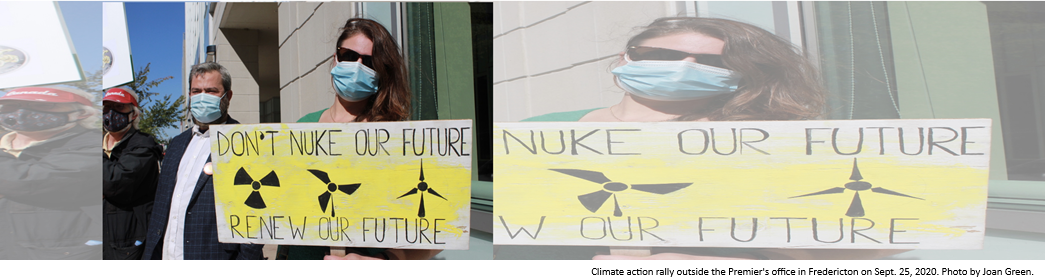
Lorneville residents and allies are organized to fight the proposed data centre and fossil gas plant. If you’re on Facebook, join the Save Lorneville group, HERE. Save Lorneville and local activist Chris Watson are CRED-NB Champions. Chris wrote a letter to the Premier outlining his concerns with the proposed project, below. The letter is an excellent summary of why many people and groups, including CRED-NB, are opposing this project.
Dear Premier Holt,
I am writing to express serious concern regarding the proposed Spruce Lake AI Data Centre project in Lorneville and the recently registered Environmental Impact Assessment, available HERE.
This proposal is being presented as progress, but the EIA describes something very different: a 390 MW data centre, a 190 MW onsite natural gas plant, an additional 200 MW load from NB Power, new transmission infrastructure, gas pipelines, a new substation, and development adjacent to a residential community on top of high-functioning wetlands, watercourses, and old growth forest.
The Government of New Brunswick speaks of net zero, climate responsibility, and environmental stewardship. Do those commitments actually mean anything in practice?
My major concerns are as follows (which only scratch the surface of the issues with this project):
– Massive greenhouse gas emissions. The EIA estimates that the onsite gas plant alone would emit roughly 755,000 tonnes of greenhouse gases per year, equivalent to about 6.6% of New Brunswick’s total 2023 emissions. This would make the project one of the province’s largest emitters.
– No guarantee of any Canadian public benefit. The “data sovereignty” pitch is highly questionable. These are American companies (Voltagrid based in Texas and Beacon’s parent company Nadia Partners based in New York, and there is no guarantee this facility will be used for Canadian data or for any clear public-interest purpose. There is nothing stopping it from serving highly resource-intensive private AI workloads with little or no meaningful benefit to New Brunswick or Canada.
– A major new load on NB Power. The EIA says the project would require 200 MW from NB Power in addition to the onsite gas plant. That raises obvious concerns about grid capacity, infrastructure pressure, and increased costs to ratepayers.
– Apparent avoidance of federal review. The proposed gas plant is set at 190 MW, just below the 200 MW threshold that can trigger federal impact assessment for a new fossil fuel-fired generating facility. That raises serious concern that the project has been deliberately sized to avoid the higher scrutiny and stronger protections a federal review could have brought to our community.
– Nothing stops future expansion. If 190 MW is accepted now, what prevents that load from increasing later while still avoiding a Federal Impact Assessment? Any increase would mean even more fossil fuel burning and even more greenhouse gas emissions.
– Destruction of high-functioning wetlands and old forest. The project would be built on top of wetlands that currently provide water storage, runoff moderation, wildlife habitat, carbon storage, and climate resilience. The EIA also explicitly states that forest meeting the definition of old growth would be destroyed as a “long-term, irreversible, adverse effect.” In any responsible, forward-thinking society, in this day and age, old growth forest should be unconditionally protected, particularly in NB where we have so little left.
– Groundwater, wells, and downstream ecosystem risks. The EIA acknowledges pathways by which blasting, drainage alteration, dewatering, and sedimentation could affect groundwater and nearby private wells. There also appears to be no clear dedicated assessment of impacts on downstream salt marsh or estuarine systems.
– Serious sound and quality-of-life concerns. The EIA’s noise assessment is gravely insufficient. It relies on a single winter baseline survey at one location (on my property) next to a snowmobile trail in February, which is frequented by passing snowmobiles at night. The reported nighttime baseline is based on hourly average dBA values elevated by intermittent vehicle pass-bys, and do not reflect the true quiet conditions residents experience overnight. The assessment also did not include measured baseline dBC monitoring tailored to low-frequency noise. That is a major omission, because resident concern is not simply about average sound levels on paper. It is about the risk of a persistent low-frequency industrial hum from continuous operation of engines, chillers, pumps, and transformer equipment. That kind of sound can seriously affect sleep, stress, mental well-being, and overall quality of life for nearby families.
Given these concerns, I am again asking your government to impose an immediate moratorium on data centre developments of this kind in New Brunswick until an appropriate policy and regulatory framework is in place.
This type of project is not suitable for high ecological value land, not suitable immediately next to a residential community, and not suitable given our responsibility to future generations to address the dire immediate and long-term consequences of our changing climate.
New Brunswick cannot credibly claim climate leadership, environmental stewardship, or a serious commitment to net zero while advancing projects that combine major new fossil-fuel emissions with destruction of wetlands and old forest.
Sincerely,
Chris Watson
1520 Lorneville Road
Saint John, NB E2M 7H6