Prototype reactors for NB are not part of climate action plan

Both the federal and New Brunswick governments are claiming that the prototype nuclear reactors will help to tackle the climate crisis.

CRED-NB member Susan O’Donnell from the UNB RAVEN project writes two articles in the NB Media Co-op on this topic. You can read them by clicking on the headlines below.

Are New Brunswick’s prototype nuclear reactors part of a climate action plan?

Why are the federal and New Brunswick governments funding prototype nuclear reactors?

CRED-NB and national groups to the Prime Minister: stop funding new nuclear reactors

Visit crednb.ca for information missing from industry and government websites about nuclear power

A network of groups across the country including CRED-NB sent a letter to the Prime Minister asking that any further government commitment to the development of small modular nuclear reactors must be put on hold and a process established to permit Canadians to have their say and evaluate the economic, societal and environmental cases for and against nuclear energy expansion.

You can read the letter here:
www.ccnr.org/SMR_Letter_to_PM_Nov_5_2020.pdf

The letter is accompanied by a media release from Oct. 20 explaining why the new nuclear reactors are “Dirty Dangerous Distraction”:
www.ccnr.org/SMR_DDD_Media_Oct_20_2020.pdf

Why hasn’t Canada signed the UN nuclear weapons ban treaty?

CRED-NB is endorsing a panel event on Nov. 19 organized by the Canadian Foreign Policy Institute. The event is free and features speakers from across the political spectrum, MPs from the NDP, Greens, Liberals and Bloc Québécois. For more info and to sign up for the event, visit this site. The question from CRED-NB is: what is the link between the civilian nuclear industry and the nuclear weapons industry? We know some of the story and would like to learn more!

Federal government suppressing dissent on nuclear energy


CRED-NB members Sam Arnold, with the Sustainable Energy Group in Carleton County, and Susan O’Donnell, with the RAVEN project at the University of New Brunswick, published an article today in The Hill Times. Their article describes how the federal government is blocking groups and individuals opposed to new federal funding for nuclear reactors from expressing their opinions through the usual government channels. You can read their article here.

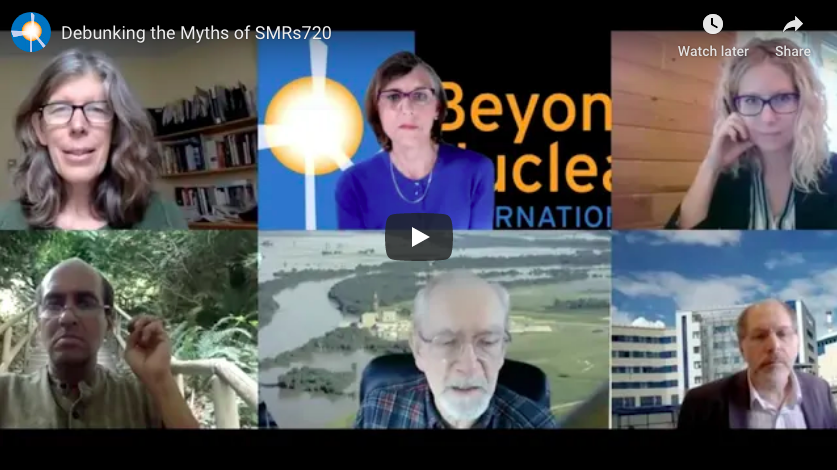
Debunking the myths about SMRs

The video of the Beyond Nuclear webinar held Oct. 21 is available on our website, the Videos tab. Experts from Canada and the US discuss the common myths about SMRs and offer research and evidence to clear up misconceptions. CRED-NB and the Canadian Environmental Law Association (CELA) were co-hosts of this event.

“Next generation” nuclear reactors are a dirty, dangerous distraction from tackling the climate crisis

Groups say federal funding of new nuclear reactors is a “dirty, dangerous distraction” from tackling climate change

Ottawa, October 20, 2020 — Public interest groups across Canada are criticizing the federal government for funding small nuclear reactor development and are challenging the government to release the research and data that support its strategy.

Ministers Seamus O’Regan and Navdeep Bains last week announced a $20 million grant to Terrestrial Energy in Ontario to continue developing a molten salt reactor. More funding announcements for new nuclear reactors are expected in the coming weeks.

The federal funding for new nuclear energy is opposed by groups from BC to New Brunswick, including the West Coast Environmental Law Association, Friends of the Earth Canada, Greenpeace Canada, Canadian Environmental Law Association, Environmental Defence, Coalition for Responsible Energy Development in New Brunswick, Coalition for a Clean Green Saskatchewan, Concerned Citizens of Manitoba, Northwatch, Sierra Club Canada Foundation, Ralliement contre la pollution radioactive, Équiterre and the Canadian Coalition for Nuclear Responsibility.

The groups say “next generation” nuclear reactors are a dirty, dangerous distraction from tackling the climate crisis. Nuclear energy is not green, not clean, too costly and too slow to build.

The groups charge that the federal government is trying to save the nuclear industry rather than saving the environment and protecting health.

The groups say that:

SMR development is too slow to address the climate crisis:

The 2020 World Nuclear Industry Status Report says that developing new nuclear energy is too slow to address the climate crisis – as well as more expensive – compared to renewable energy and energy efficiency.  No SMRs have yet been built and the models being proposed will take a decade or more to develop.

SMRs are more expensive than renewable energy:

A Canadian study found that energy from small nuclear reactors would be up to ten times the cost of renewable energy.  In the past decade, the cost of building solar, wind power and battery storage has gone down dramatically, while the cost of building new nuclear reactors has gone up. Small reactors will be even more expensive per unit of power than the current large ones.

Nuclear power creates fewer jobs than renewable energy:

Renewable energy is one of the fastest-growing job sectors in North America.  An American study found that solar energy leads to six times as many jobs as nuclear power for each gigawatt-hour of electricity generated.

There are better sources of energy:

Minister O’Regan has said repeatedly, without providing evidence, that there is no path to net-zero greenhouse gas emissions without nuclear energy. In fact, on the contrary a new study of 123 countries over 25 years found that countries that invested in renewable energy lowered their carbon emissions much more than those reliant on nuclear energy.

SMRs are dirty and dangerous:

The new “small” reactors, proposed to be built across Canada, will produce radioactive waste of many kinds. Some of the proposed models would extract plutonium from irradiated fuel, worsening concerns about weapons proliferation and creating new forms of radioactive waste that are especially dangerous to manage. The federal government currently has no detailed policy or strategy for what to do with radioactive waste, and no design or location for a deep underground repository where industry proposes to store high-level radioactive waste for hundreds of thousands of years.

The federal government has never consulted the public about small modular reactors, which would create environmental risks and financial liabilities for Canadians.

Public Interest Groups Opposing SMR Funding:

Action Climat Outaouais (Que.)
Canadian Association of Physicians for the Environment
Canadian Coalition for Nuclear Responsibility
Canadian Environmental Law Association
Citizens’ Network on Waste Management (Ont.)
Coalition Against Nuclear Dumps on the Ottawa River (Ont.)
Coalition for a Clean Green Saskatchewan
Coalition for Responsible Energy Development in New Brunswick
Committee for Future Generations (Sask.)
Concerned Citizens of Manitoba
Concerned Citizens of Renfrew County and Area (Ont.)
Environmental Defence
Équiterre
Extinction Rebellion New Brunswick
Friends of the Earth Canada
Greenpeace Canada
The Inter-Church Uranium Committee Educational Cooperative (Sask.)
Leap4Wards, Saint John, NB
MiningWatch Canada
Northwatch
Nova Scotia Voice of Women for Peace
Old Fort William Cottagers’ Association (Que.)
Ontario Clean Air Alliance
Ralliement contre la pollution radioactive (Que.)
RAVEN project at the University of New Brunswick
Saint John Chapter of Council of Canadians
Sierra Club Canada Foundation
Sustainable Energy Group, New Brunswick
VOICES for Sustainable Environments and Communities (N.B.)
West Coast Environmental Law Association (B.C.)

– 30 –

Media contacts:

Kerrie Blaise

Tel: 416-960-2284 ext 7224

kerrie@cela.ca

Eva Schacherl

evaschacherl@gmail.com

613-316-9450


Why is the federal government funding new nuclear power reactors?

Today, the government made its first SMR funding announcement: $20 million from ISED’s Strategic Innovation Fund for the company Terrestrial Energy to develop its prototype SMR in Ontario.

Anyone interested in evidence-based policy is wondering: Why are they doing this? There is no evidence that nuclear power will achieve carbon reduction targets, while there is considerable research indicating the contrary.

In fact, in today’s funding announcement, federal Natural Resources Minister Seamus O’Regan confirmed that the new reactor will take more than a decade to develop and will contribute nothing to Canada’s 2030 target for reducing greenhouse gas (GHG) emissions.

Read the rest of the story on Rabble by author Susan O’Donnell, lead researcher of the RAVEN project and CRED-NB member.

Invitation to webinar: Debunking the myths around Small Modular Nuclear Reactors (SMRs)

The New Brunswick government and NB Power are supporting the development of two new nuclear reactors on the Bay of Fundy at Point Lepreau.

Join a webinar to learn from international experts about the risks of the new reactors, information missing from the NB Power website.

Day: Wednesday, October 21

Time: 3pm Atlantic | 2pm Eastern | 1pm Central | noon Mountain | 11am Pacific

Click this zoom link to register for the event: 

https://us02web.zoom.us/…/reg…/WN_8Vm58sHFTaOiZe2dfhC_ZQ

The event is co-hosted by Beyond Nuclear and Coalition for Responsible Energy Development in New Brunswick (CRED-NB) and the Canadian Environmental Law Association. (CELA)

Panelists:
KERRIE BLAISE , Staff Lawyer, Canadian Environmental Law Association.
EDWIN LYMAN, Director of Nuclear Power Safety, Union of Concerned Scientists.
M.V. RAMANA, Simons Chair in Disarmament, Global and Human Security and Director of the Liu Institute for Global Issues at the School of Public Policy and Global Affairs, University of British Columbia.

Moderator: Linda Pentz Gunter, international specialist, Beyond Nuclear;
Host: Paul Gunter, director, Reactor Oversight Project, Beyond Nuclear;
Co-host: Susan O’Donnell, lead researcher on the University of New Brunswick’s RAVEN project, a member of CRED-NB.
And with contributions by Dr. Gordon Edwards (Canada) and Dr. David Lowry (UK).

Small “Mythical” Reactors, also known as small modular reactors, or, more properly, small modular nuclear reactors, are uneconomical, years away from implementation, don’t answer the climate crisis or jobs needs, and come with the same inherent risks and radioactive waste problems as the current large reactors. Yet the nuclear industry, governments and the media continue to embrace them as something “new” and beneficial.

Learn how to make the case that small modular nuclear reactors:
-Have no role in climate action;
-Could jeopardize security and safety;
-Will cost as much as traditional reactors;
-Won’t deliver the promised jobs panacea;
-Are intrinsically tied to the nuclear weapons sector; and more.

Click this zoom link to register for the event: https://us02web.zoom.us/…/reg…/WN_8Vm58sHFTaOiZe2dfhC_ZQ

Facebook event notice:https://www.facebook.com/events/281651552876737

Hope you can join us!

Throne speech signals Canada’s support for new nuclear reactors, opposition builds in New Brunswick

Photo by Joan Green. Climate Action Rally in Fredericton at the office of the premier, Sept. 25, 2020.

Read the NB Media Co-op story here.

For more than a year, renewable energy and anti-nuclear activists in New Brunswick and across the country have watched nuclear industry lobbyists re-position their product as the solution to the climate crisis. Indeed, days before the Throne Speech, federal Natural Resources minister Seamus O’Regan claimed that nuclear power was necessary for Canada to meet its net-zero emissions target.

Given its legacy of toxic radioactive waste, nuclear energy would not be considered “clean technology” by most Canadians. However the nuclear industry has been working hard to scrub its image.

Climate Action rally in Fredericton: Don’t Nuke Our Future!

Photo by Joan Green. Climate Action Rally in Fredericton at the office of the premier, Sept. 25, 2020.

Read the NB Media Co-op story about the rally, here.

New Brunswick residents want climate action and a nuclear-free renewable energy future. CRED-NB member Extinction Rebellion New Brunswick (XR NB) organized a rally Sept. 25, the Global Day of Climate Action, outside the office of the premier of New Brunswick. The message to our political leadership was clear: no new nukes for New Brunswick!

Speakers included David Coon, MLA for Fredericton South and leader of the Green Party of New Brunswick, Doug Swain of XR NB, Jessica Spencer of XR NB, Chris Rouse of New Clear Free Solutions and Ron Tremblay, Chief of the Wolastoq Grand Council.

CRED-NB buttons: More Nuclear? No Thanks! were distributed widely.